
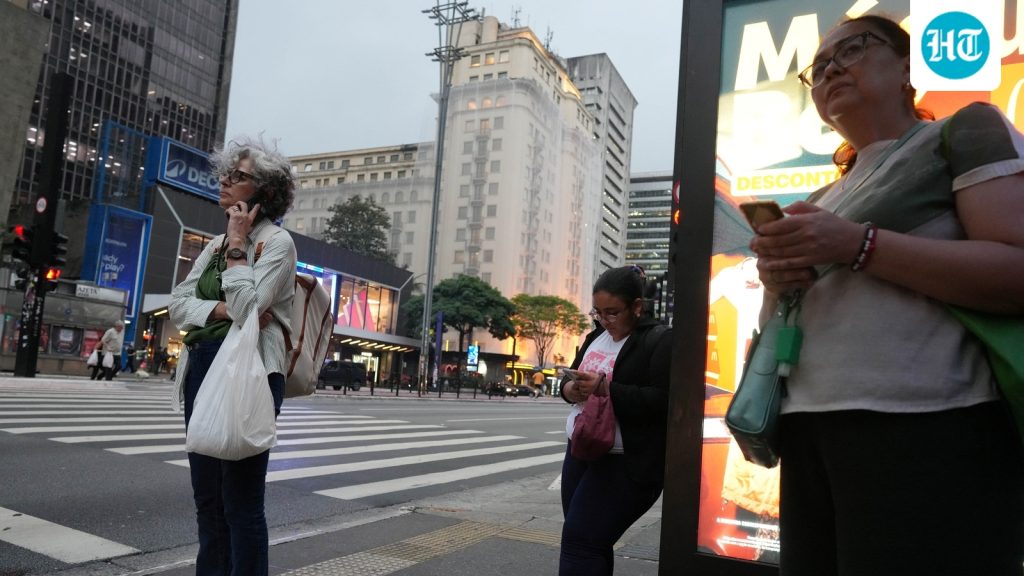
Cellphone Crime Takes Center Stage in Brazil’s Presidential Contest
Bharatmorning.com – A violent robbery caught on a dashboard camera has become a powerful illustration of a wider public-security anxiety in Brazil, where the loss of a phone can also mean losing access to money, personal information and everyday services.
Content creator Tabata Lenk was sitting in São Paulo traffic shortly after losing her job when two people on a motorcycle broke her car window and seized a new cellphone that had been placed on the dashboard. Video of the late-August attack spread quickly online, bringing intense attention to a crime that has become an election issue.
Phone theft has declined since 2023, yet its scale remains significant. Brazil registered about 830,000 stolen phones last year, Brazilian Public Security Forum data shows. The issue has retained its political force even as the country’s broader homicide rate has fallen substantially over the past decade.
Brazil’s homicide rate reached 15.4 per 100,000 people in 2025, down 40% from 10 years earlier. For a population exceeding 210 million, however, street crime involving devices remains an immediate and familiar concern. A March survey placed cellphone theft as the fourth-largest safety worry among Brazilians, ahead of concerns over stray bullets and burglaries.
A Device That Holds Daily Life
The political resonance of stolen phones reflects the central role they play in Brazilian life. Brazil is among the world’s most connected societies, with social networks, digital banking and electronic payments deeply woven into daily routines. A phone is often more than a communications tool: it can be a wallet, bank branch, camera, work device and repository of personal records.
Natasha Bachini Pereira, a researcher at the University of São Paulo’s Center for the Study of Violence, said the frequency of these crimes makes them especially visible to voters.
“It’s far more common for someone to know of, or have been exposed to, a case of cellphone theft than a car theft, a homicide, or a kidnapping,” Pereira said.
Replacing a device can also impose a steep financial burden. Deutsche Bank research found that Brazil has the world’s second-most expensive iPhone 17 Pro, with a new handset selling for roughly $2,260, compared with $1,181 in the United States. Tariffs, taxes and a weaker currency contribute to the difference.
Less expensive models still represent a major purchase. IDC market data put the average cellphone price at around 2,310 reais, or $456.83, in 2025—roughly two-thirds of Brazil’s average monthly income.
Security Pledges in a Tight Race
President Luiz Inácio Lula da Silva and right-wing challenger Flavio Bolsonaro have both made phone theft a prominent part of their public-safety messaging before next Sunday’s closely contested presidential runoff.
Lula, the incumbent, approved legislation this year that allows prison terms of up to 10 years for theft involving electronic devices. His government also introduced a platform intended to help people register phones and report thefts. Bolsonaro has proposed an eight-year minimum sentence for the crime.
“I only want to take aim at the thief and the store that buys and sells the (stolen) phone, I don’t want to harm the innocent person who bought it out of necessity,” Lula said in a televised address.
“The cellphone thief is going to jail,” Bolsonaro said in a livestream after the first-round vote.
The debate extends beyond the person who grabs the handset. Officials and candidates have focused attention on the resale market for stolen devices, as well as the financial fraud that can follow when criminals gain access to unlocked phones.
From Theft to Digital Fraud
Brazil’s rapid expansion of digital financial services has increased the stakes. The central bank’s Pix payment system has made instant transfers a routine part of commerce and personal finance, but stolen devices can give criminals an opportunity to target bank accounts as well.
Fraud involving stolen phones rose more than fourfold between 2024 and 2025, Brazilian Public Security Forum figures indicate. Lenk said thieves used Pix to remove 2,000 reais from her account after taking her phone.
“It’s terrible to experience the violence of having your cellphone stolen, but realizing that someone invaded your privacy and managed to steal money from your account is downright agonizing,” Lenk said.
For victims, the aftermath can reshape everyday behavior. Lenk said she did not drive alone again until she had her car windows tinted.
“No one should be afraid to leave their house, walk in the street, or use their own cellphone,” Lenk said. “So, I believe choosing politicians committed to public safety is essential.”
São Paulo’s Challenge
São Paulo state, Brazil’s most populous, accounts for nearly one-third of phone thefts across the country. Authorities recorded 268,184 stolen devices there last year.
Rodolfo Latif Sebba, a civil police chief coordinating efforts to locate stolen handsets, said police forces across the state are working to curb theft and strengthen public safety as aggressively as possible.
Recovery remains difficult. From June 2025 through September 23 this year, São Paulo state police recovered 38,028 cellphones and returned 11,445 of them to people who had reported thefts. The gap highlights a persistent problem: finding a device does not always make it possible to identify and reach its original owner.
For 17-year-old student Natalia Eduarda Benvindo, getting her stolen phone back was so unexpected that she initially thought police could not be serious.
“I asked, ‘are you joking?’” Benvindo said.
Her reaction captures why cellphone theft has become such a potent election flashpoint. The crime may be less lethal than other forms of violence, but its consequences reach into a person’s finances, privacy, mobility and feeling of safety—often all at once.
Related Reading
Frequently Asked Questions
What is Brazil s love affair with cellphones?
Brazil s love affair with cellphones is the main topic of this guide. The article explains the context, practical details, and next steps readers should understand.
Why does Brazil s love affair with cellphones matter?
Brazil s love affair with cellphones matters because readers are looking for a useful answer, not just a short summary. Good content should match search intent and help them decide what to do next.