
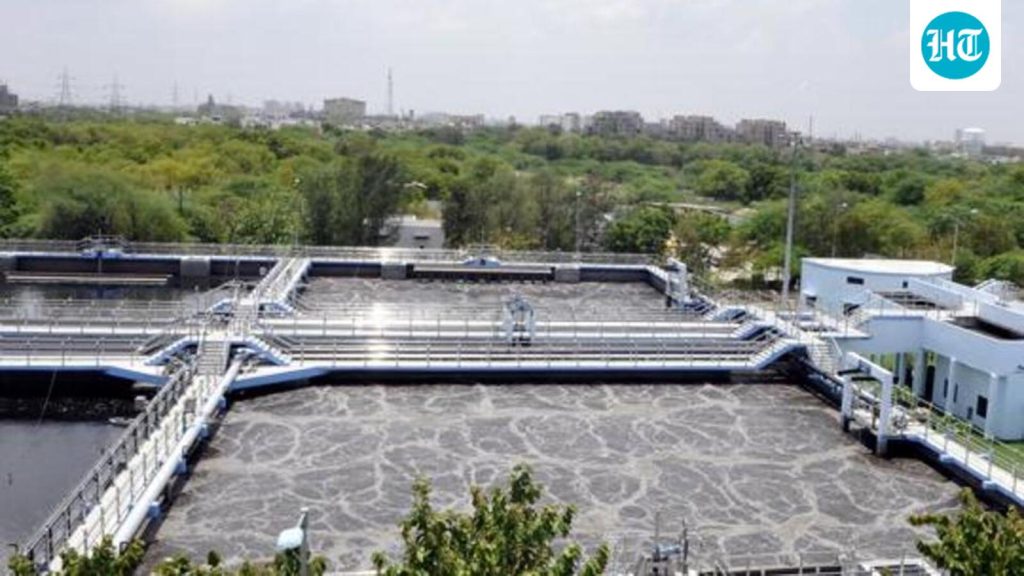
India’s Wastewater Push Must Deliver More Than Construction Targets
Bharatmorning.com – India’s sanitation agenda has moved far beyond building household toilets. The harder challenge now is ensuring that sewage, faecal sludge and used water are collected, treated and, wherever feasible, reused instead of being released into drains, rivers, lakes or open areas.
The Swachh Bharat Mission completed 12 years earlier this month, and its later standards reflect this broader goal. The Open-Defecation-Free Plus Plus protocol, introduced in 2018, required urban areas to prevent untreated sewage and faecal sludge from entering water bodies, drains and land. A year later, the Water+ protocol raised expectations further by calling for treatment and reuse of wastewater generated by homes and commercial establishments.
That ambition has not always been matched by financial support. Under the mission, used-water management funding has focused on towns with populations below one lakh. Bigger urban centres have largely depended on programmes such as AMRUT and Namami Gange for wastewater investments.
A larger grant for growing cities
The 16th Finance Commission has attempted to address part of that funding gap. It has earmarked ₹56,100 crore through a Special Infrastructure Grant for 22 cities with populations from one million to four million. The money is intended to strengthen wastewater and stormwater systems.
Once the required 40% contribution from states and urban local governments is added, the overall programme could reach roughly ₹93,000 crore over five years. For cities with more than 1.5 million residents, this works out to around ₹5,000 crore each; cities below that population threshold could receive approximately ₹3,500 crore each.
The comparison with earlier assistance is striking. These cities had received only about ₹300 crore to ₹500 crore on average for similar work under AMRUT. The new allocation therefore represents a major increase in the financial capacity available for urban water infrastructure.
Its focus is equally important. Nearly 72% of sewage generated in Indian cities is still discharged without treatment, while stormwater drainage has frequently received inadequate investment. The grant requires cities to prepare integrated wastewater-management plans, encouraging them to look beyond isolated treatment plants or individual drain works and plan systems at the city scale.
Why implementation will decide the outcome
Money alone will not solve the problem. The key questions are what infrastructure will be created, whether it is designed for actual demand, how long delivery takes, how costs are managed and who remains responsible after construction is finished.
The choice of 22 fast-growing cities is sensible. Rapid migration has placed heavy pressure on their public services, and they face the risk of repeating the familiar pattern seen in larger metros: population and wastewater generation rising much faster than network and treatment capacity.
Yet previous projects provide a warning. Pune’s ₹990 crore Mula-Mutha Pollution Abatement Project was approved in 2016 but was only about 70% complete by late 2024. In Patna, two projects among 11 Namami Gange packages approved between 2014 and 2017 were still unfinished more than eight years later. Ludhiana’s Buddha Nullah project crossed six missed deadlines before it was completed. Faridabad’s sewage-treatment-plant upgrades, begun in 2019-20, missed four deadlines.
These examples point to persistent weaknesses in urban infrastructure delivery. Delays often begin before construction, when detailed project reports, approvals and procurement take far longer than planned. Pune’s work orders were issued six years after the project began. In Patna, treatment plants have progressed ahead of the sewer networks and household connections needed to bring wastewater to them.
Project boundaries can also be too narrow. Ludhiana’s work was formally completed in 2024, but regulators have acknowledged that the water remains unsuitable even for irrigation because untreated industrial effluent continues to enter the system. Faridabad illustrates another problem: its treatment requirement is about 500 million litres per day, while planned works cover only around one-third of that need.
Plan for the full service, not isolated assets
The new grant should be designed around infrastructure realities. Wastewater and stormwater systems commonly need seven to ten years for planning, construction and operational stabilisation. A five-year Finance Commission period should not force cities to squeeze complex projects into an unrealistic deadline.
Cities need room to commit and spend funds beyond the award cycle. At the same time, states and urban local governments should not rush poorly prepared proposals simply to secure an allocation. Weak detailed project reports, incomplete assessments of climate resilience and unclear network plans can later produce scope changes, cost overruns and years of delay.
Funding should also be linked to results instead of simply to completed components. A sewage treatment plant has limited value if sewers do not connect to it, households are excluded, industrial discharges continue unchecked or the operator cannot keep the plant functioning. The service chain must work from collection through conveyance, treatment, discharge or reuse.
Contracts should therefore make firms responsible for construction as well as long-term operations and maintenance, with payments tied to actual performance. Build-and-exit arrangements should be exceptional. The method by which users contribute to service costs also needs to be settled early, rather than becoming an afterthought once assets have been commissioned.
Urban local governments need real ownership
The most consequential reform may be institutional. Thirty-three years after the 74th Constitutional Amendment, many urban local governments remain recipients of assets built by parastatal agencies rather than active owners of systems serving their residents.
This grant offers an opportunity to change that relationship. Urban local governments should become the legal owners of the wastewater and stormwater infrastructure created with these funds. Ownership must come with operational authority, technical capacity and clear responsibility for maintaining services over time.
Comptroller and Auditor General compendiums indicate that urban local governments spend only about 61% of the funds available to them. That underlines the need for stronger local project preparation, procurement and financial-management capacity. Without it, even an unprecedented allocation may sit unused or be converted into incomplete assets.
India has the chance to make urban sanitation more durable, cleaner and more responsive to the realities of growing cities. The test will not be the scale of money announced, but whether it produces functioning networks, reliable treatment, cleaner water and accountable local institutions.
Related Reading
Frequently Asked Questions
What is Waste water not funding should go down?
Waste water not funding should go down is the main topic of this guide. The article explains the context, practical details, and next steps readers should understand.
Why does Waste water not funding should go down matter?
Waste water not funding should go down matters because readers are looking for a useful answer, not just a short summary. Good content should match search intent and help them decide what to do next.