
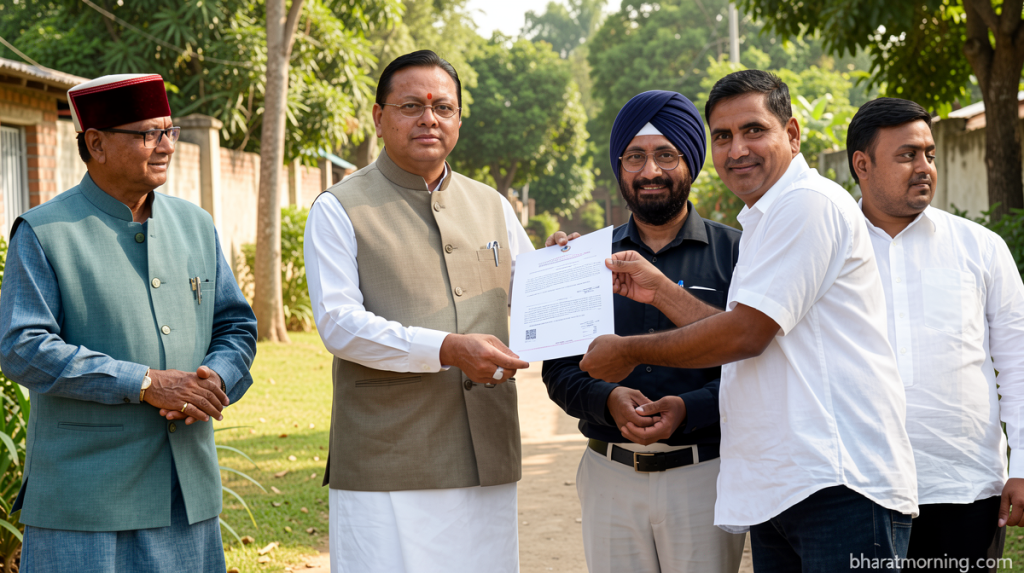
Uttarakhand Expands Rural Extension Workforce with 101 New Livestock and Sugar Officials
Bharatmorning.com – At the Chief Minister Camp Office in Dehradun, Uttarakhand’s top leader Pushkar Singh Dhami formally inducted a new cohort of 101 government employees into two departments that sit at the heart of the state’s agrarian economy. The batch comprises 88 Livestock Extension Officers assigned to the Animal Husbandry Department and 13 Sugarcane Supervisors placed under the Sugarcane Development and Sugar Industry Department. The ceremony, held on Thursday, marked the handover of official appointment letters to each selected candidate.
Merit-Based Recruitment After Years of Scrutiny
The appointment event carried a broader political message beyond the individual recipients. Dhami framed the exercise as evidence that Uttarakhand’s public-sector hiring has shifted decisively toward merit and talent, a claim he anchored in the state’s recently enforced anti-copying statute designed to eliminate malpractice in competitive examinations. Under that legal framework, candidates must write answers independently, with penalties attached to any detected collusion.
“Government jobs are now being secured on merit and talent,” Dhami told the assembled appointees, adding that more than 34,000 young residents had obtained government positions over the preceding five-year period.
For a hill state of roughly 4.5 million people, where public-sector employment remains one of the most sought-after career paths, the cumulative figure of 34,000 placements represents a substantial share of the working-age population entering salaried government roles. The anti-copying law, introduced to address long-standing allegations of answer-sheet circulation in state-level examinations, has become a recurring talking point in Dhami’s public addresses.
Why These Two Departments Matter in a Hill Economy
Uttarakhand’s terrain — dominated by the Garhwal and Kumaon ranges, with limited flat agricultural land — makes livestock rearing and small-scale sugar cultivation disproportionately important to rural household income. Unlike plains states where cereal grains dominate, hill families here depend heavily on dairy animals, small ruminants, and poultry for both nutrition and cash earnings. The Animal Husbandry Department’s extension officers serve as the last-mile link between state policy and the farmer’s doorstep, delivering veterinary care, breeding guidance, and scheme information to scattered hamlets where road access can be seasonal.
Dhami underscored this connection, noting that the two departments are directly tied to the rural economy and that livestock rearing underpins the livelihoods of thousands of hill families while also advancing women’s economic empowerment through dairy and poultry micro-enterprises.
Scheme Architecture Behind the Extension Workforce
The new appointees will operate within a web of state-specific programmes designed to lift productivity in animal husbandry and sugar cultivation. Three flagship initiatives anchor the livestock side:
Mukhyamantri Aanchal Amrit Yojana targets integrated rural development at the district level, bundling infrastructure inputs with agricultural support. Mukhyamantri Ghasyari Kalyan Yojana focuses on fodder and pasture development, addressing the perennial feed shortage that constrains dairy output in high-altitude zones. Mukhyamantri State Livestock Mission coordinates breeding, disease control, and value-chain development across the state’s animal husbandry infrastructure.
Complementing these programmes, the government extends subsidised units for cow, goat, sheep, and poultry rearing, alongside subsidised access to artificial insemination services, vaccination drives, and veterinary care. For a hill farmer whose nearest veterinary clinic may be a day’s walk away, the extension officer’s presence in the block or sub-division becomes the practical difference between a functioning scheme and a paper promise.
Sugarcane: Transparency and a Price Premium
On the sugar side, Dhami highlighted structural reforms aimed at building farmer confidence. Sugarcane area surveys have been migrated to online platforms, reducing the scope for manipulation in acreage reporting. Sugarcane clinics and advisory centres now provide field-level guidance on improved varieties, scientific cultivation practices, and post-harvest handling.
A concrete economic incentive accompanies these measures: Uttarakhand’s sugarcane farmers receive a rate five rupees higher per quintal than the prevailing price in neighbouring Uttar Pradesh. In a state where sugarcane is grown primarily in the lower-lying Kumaun belt and select Garhwal valleys, that premium — however modest in absolute terms — is designed to keep local mills supplied and discourage diversion of cane to adjacent states.
Operational Mandate for the New Cohort
Closing his remarks, Dhami directed the 101 appointees to ensure that government schemes reach beneficiaries on schedule and with full transparency, and to engage farmers and livestock owners with sensitivity appropriate to hill-community dynamics. He invoked a four-word operational principle — simplification, solution, disposal, and satisfaction — as the behavioural compass for their daily duties, pairing it with expectations of honesty and discipline.
“Use your knowledge, energy, and new ideas to improve government functioning,” he urged the newly inducted officers, congratulating them on what he described as the culmination of hard work, discipline, and determination.
The induction adds to an already expanding state bureaucracy in a period when Uttarakhand’s rural development agenda — spanning disaster-resilient agriculture, women’s self-help groups, and cold-chain logistics for perishables — demands a larger, better-trained extension cadre. Whether the 101 new officers can translate policy intent into measurable gains at the village level will depend on terrain access, local-language communication, and the willingness of gram panchayats to cooperate with departmental field teams. The appointment letters, in other words, are a beginning rather than an endpoint.
Related Reading
Frequently Asked Questions
What is Uttarakhand CM Dhami gives appointment letters?
Uttarakhand CM Dhami gives appointment letters is the main topic of this guide. The article explains the context, practical details, and next steps readers should understand.
Why does Uttarakhand CM Dhami gives appointment letters matter?
Uttarakhand CM Dhami gives appointment letters matters because readers are looking for a useful answer, not just a short summary. Good content should match search intent and help them decide what to do next.