
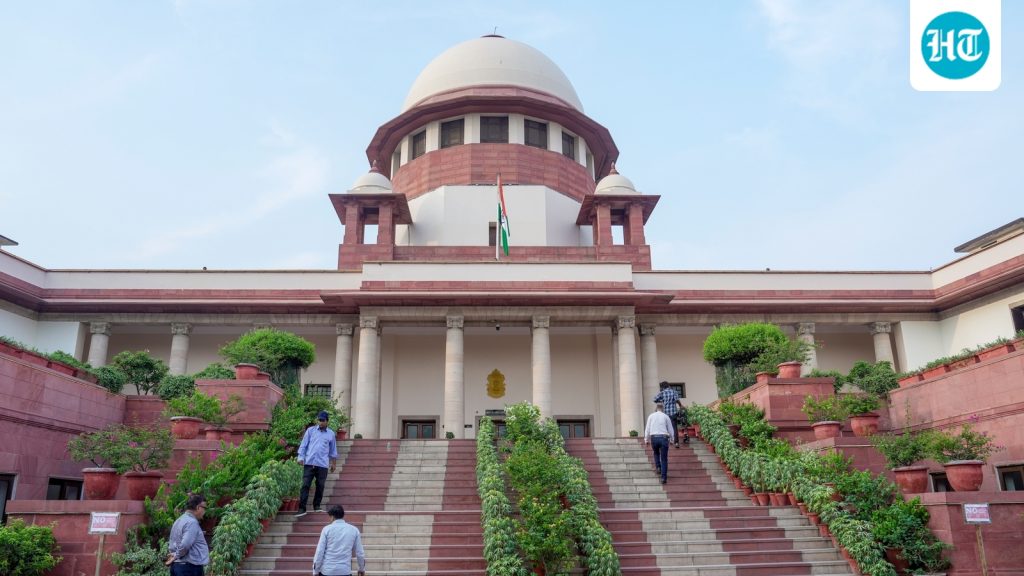
Supreme Court Questions UP Police Over FIR Naming ‘Unknown’ Accused
Bharatmorning.com – The Supreme Court on Wednesday sharply criticised the Uttar Pradesh Police after an accused person allegedly caught at the scene was still described as “unknown” in a first information report. The bench warned that such handling of criminal cases can erode public faith in the police and raised the possibility of transferring investigations to the Central Bureau of Investigation.
Justices Sanjay Kumar and Sanjeev Sachdeva were examining a complaint brought before the court by a woman who appeared in person. She said that she had apprehended a man riding a motorcycle during the incident and handed him over to police personnel. Despite this, the FIR did not identify him by name and instead recorded the accused as unknown.
“How will people trust you if this is how you proceed with matters. In everything you seem to have an agenda,”
The judges addressed the state over the apparent discrepancy between the woman’s account and the police record. The court treated the issue as more than a clerical lapse, focusing on whether the FIR had accurately reflected the circumstances in which the suspect was taken into custody.
Court Seeks Explanation From Officer
The bench directed that the police officer concerned be present at the next hearing. The officer has been asked to explain what the court described as a possible “cover-up” in the registration of the case.
An FIR is generally the formal starting point for a criminal investigation. Its contents can shape the early direction of an inquiry, including the identification of suspects, collection of evidence and the steps taken by investigators. When a person is allegedly apprehended and handed to police, recording that circumstance accurately is central to ensuring that the case proceeds on a clear factual foundation.
The court’s concern was that a record listing an accused as unknown despite an alleged on-the-spot apprehension could create doubts about the integrity of the investigation. The judges indicated that public confidence depends on police records reflecting material facts fairly and without selective omissions.
“It is better that we disband the UP police and ask the CBI to step into all your investigations. This nonsense has to stop at some point.”
The remarks underline the court’s frustration with what it viewed as an unacceptable pattern of investigative conduct. The CBI is a central investigating agency, and a judicial direction to hand over cases to it is ordinarily treated as an exceptional intervention. By referring to such a possibility, the bench signalled the seriousness with which it viewed the allegations in this matter.
Question Raised Over Motorcycle Registration
The petitioner also questioned the handling of the motorcycle connected to the accused. She told the court that when the man was handed over, she noticed that the vehicle did not have a registration plate. During the later investigation, however, a registration number was assigned to the motorcycle.
That sequence drew another stern observation from the bench. The judges suggested that the actions described went beyond routine compliance or deference to an official position.
“Toeing the line is one thing but you are bending over backwards.”
The case now places the focus on the explanation to be offered by the police officer at the next hearing. The court will likely examine how the accused was recorded in the FIR, what information was available at the time of registration, and how the motorcycle’s identification details entered the investigation.
For members of the public, the proceedings highlight why the first police record in a criminal matter matters so much. An FIR is not the final word on guilt or innocence, and an investigation may develop as new material emerges. Even so, the document is expected to set out the basic complaint and known facts as they exist when the case is registered.
Accurate documentation is particularly important where a complainant alleges that a suspect was detained at the scene. If the identity of such a person is omitted or described inconsistently, questions can arise about whether evidence was properly preserved, whether the investigation followed the available leads, and whether the complainant’s account received due consideration.
The Supreme Court’s intervention does not decide the underlying criminal allegations. Instead, it concerns the conduct of the investigation and the reliability of the police response. The forthcoming appearance of the concerned officer is expected to give the state an opportunity to clarify the disputed FIR entry and the issue surrounding the motorcycle registration.
The bench’s observations also carry a wider message for investigative agencies: public trust is built not only through arrests or case filings, but through records that are complete, transparent and capable of scrutiny. When courts find apparent gaps between a complainant’s version and official documentation, those gaps can become central to the credibility of the entire process.
Related Reading
Frequently Asked Questions
What is Better to disband UP Police?
Better to disband UP Police is the main topic of this guide. The article explains the context, practical details, and next steps readers should understand.
Why does Better to disband UP Police matter?
Better to disband UP Police matters because readers are looking for a useful answer, not just a short summary. Good content should match search intent and help them decide what to do next.