
A Public-Space Test for Equality and Religious Accommodation
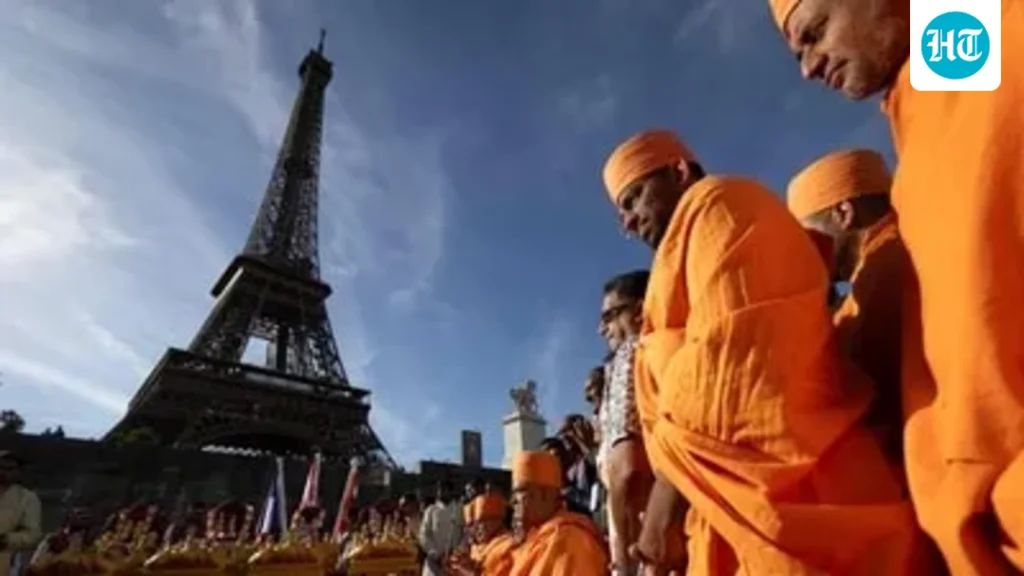
Bharatmorning.com – A visit by a large BAPS delegation to the Eiffel Tower has sparked a wider debate in France and India about religious practice, public institutions and the place of women in shared spaces. The controversy followed the recent consecration of a Bochasanwasi Akshar Purushottam Swaminarayan Sanstha temple in a Paris suburb, after which roughly 100 people connected to the organisation planned a Saturday-morning trip to the landmark.
The central facts have produced sharply different accounts. The company responsible for operating the Eiffel Tower said the group had sought arrangements intended to reduce encounters with women. BAPS, meanwhile, said through its social-media account that no one had been denied entry to the monument.
What is clear is that women employees were asked to remain out of view during the monks’ visit. The monks observe rigorous vows of celibacy, but the practical consequence of accommodating those vows was that female staff members were removed from ordinary visibility at their workplace. By Monday, the tower was closed as employees went on strike. Union representative Diane Davoine said women had felt demeaned after being asked to leave their usual work positions.
“In France, no culture, no belief, no worship, nothing nor anyone can come to dictate to women their place.”
Former French prime minister Gabriel Attal made that point forcefully, framing the episode as a question of principle rather than one limited to tourism management. Marine Le Pen, leader of the far right, expressed a similar objection.
“In France, we will never accept that the presence of women will be limited.”
Such statements naturally drew attention to France’s public commitment to equality. Yet some of the reaction also carried a familiar nationalist edge: the suggestion that France alone has settled questions that other societies have failed to confront. The deeper issue is not national pride. It is the continuing tendency to treat women’s ordinary presence as an obstacle to male religious discipline.
Celibacy Cannot Become a Burden Placed on Women
BAPS monks take vows of celibacy that are unusually strict. The organisation’s own materials describe practices intended to prevent physical contact with women. In one account from 1986, Pramukh Swami blessed two children before learning that one was a girl. The unintended contact led him to seek ritual purification in a nearby river and later undertake a fast. Another account describes his 1980 cataract surgery in Boston, when he requested that no female nurses be present, including while he was unconscious.
These examples illustrate the seriousness with which the order approaches its discipline. Individuals and religious communities are free to set demanding standards for themselves. Celibacy, dietary rules and other personal religious commitments are matters of conscience. But a private vow becomes a public problem when its observance requires other people to alter their work, movement or visibility.
Women cannot be made responsible for preserving a man’s celibacy. A vow is meaningful precisely because the person who takes it accepts responsibility for living by it. If the presence of a woman at a ticket counter, in a front-row seat or at a workplace is treated as incompatible with that commitment, then the burden has been shifted from the person observing the vow to women who did not choose it.
That shift is neither neutral nor harmless. It tells women that they must make themselves less visible so that others can maintain a particular idea of purity. In public life, visibility matters. Women have the same right as men to serve visitors, occupy prominent seats, participate in professional events and simply exist without being treated as a disruption.
A Pattern That Extends Beyond Paris
The Eiffel Tower episode was not an isolated concern. At some public BAPS events, women have been asked to sit at the back so they are not visible to monks. The organisation has itself acknowledged the possibility that such arrangements can create resentment. Pramukh Swami once declined an invitation to serve as chief guest at a ceremony honouring blood donors, reasoning that women placed behind men might come to feel alienated from the organisation.
That concern was well founded. At a 2024 gathering of chartered accountants in Kolkata, women who had already taken seats in the front were asked to move before a speech by a BAPS-linked religious leader. The setting matters: this was not a secluded monastic space designed around a voluntary religious code. It was a public professional event, where women had every reason to expect equal treatment.
India’s constitutional promise of equality and dignity makes such exclusions especially troubling. The country’s modern public life cannot rest comfortably beside practices that require women to withdraw from view. The embarrassment of seeing such attitudes exposed abroad should not distract from the more important question: why are they accepted so readily at home?
Respect Does Not Require Submission
The discussion should not collapse into mockery of Gujaratis, wealthy Indians travelling overseas or religious believers in general. There is a real and understandable irritation at conspicuous displays of privilege, whether that means treating service workers dismissively, behaving noisily in shared spaces or assuming that institutions can be tailored to private preferences. Vir Sanghvi captured part of that discomfort when he reflected on changing attitudes within his own Gujarati community.
“Over the last decade or so, as Gujarati wealth and influence have grown, something strange has happened to my people.”
But poor manners and unequal treatment are not the same issue. The more serious question raised in Paris is not whether visitors behaved ostentatiously. It is whether a public institution should ask female employees to disappear because a visiting group’s religious discipline regards their presence as a problem.
Accommodation has limits. A diverse society can reasonably make space for different diets, prayer practices, dress and schedules when doing so does not diminish the rights of others. It cannot ask one group of citizens or workers to become invisible in order to satisfy another group’s beliefs. Public spaces belong equally to everyone who enters or works in them.
That is the principle worth defending. Religious freedom includes the freedom to practise celibacy. Women’s equality includes the freedom not to be excluded for it. Neither France nor India should confuse politeness toward belief with an obligation to enforce beliefs at women’s expense.
Related Reading
Frequently Asked Questions
What is BAPS goes to Paris?
BAPS goes to Paris is the main topic of this guide. The article explains the context, practical details, and next steps readers should understand.
Why does BAPS goes to Paris matter?
BAPS goes to Paris matters because readers are looking for a useful answer, not just a short summary. Good content should match search intent and help them decide what to do next.