
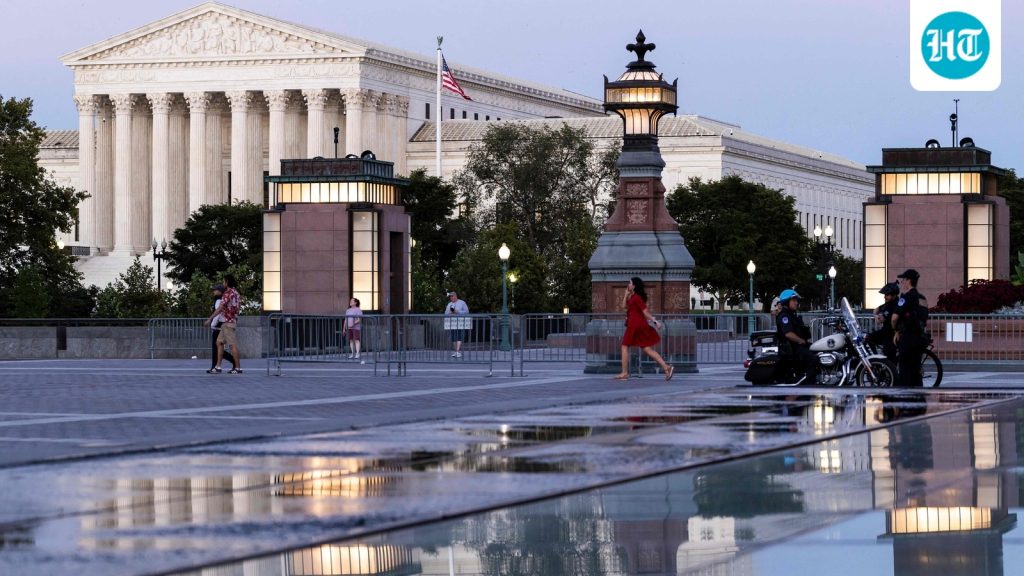
Supreme Court Blocks Trump Mail-Ballot Curbs Before Midterms
Bharatmorning.com – The US Supreme Court blocks President Trump’s proposed mail-in ballot restrictions ahead of the 2026 midterm elections, leaving existing state voting procedures in place. The court’s 7-2 order on Sept. 14 keeps a preliminary injunction in effect against new U.S. Postal Service requirements for mail and absentee ballots.
The decision means states can continue using their current systems to prepare, send and receive mail ballots for the November elections. The broader legal fight concerns whether a president can direct a federal agency to impose nationwide conditions on how states run federal elections.
Trump Executive Order Led to Court Challenge
The dispute began in March 2026, when President Donald Trump issued an executive order concerning federal election integrity. The directive instructed the U.S. Postal Service to create uniform standards for federal mail and absentee ballots, including requirements involving ballots and their envelopes.
It also called for states to provide the Postal Service with lists of voters eligible to cast mail or absentee ballots at least 60 days before Election Day. Under the proposed approach, the Postal Service could refuse ballots that did not meet its standards or came from voters not listed in the state-provided information.
State officials and voting-rights organisations filed separate lawsuits, arguing that the administration lacked authority to alter election procedures through executive action. They said the proposed rules could prevent eligible voters from having their ballots delivered and counted.
The Elections Clause assigns authority over the time, place and manner of federal elections to states and Congress.
Why the Supreme Court Left the Injunction in Place
The US Supreme Court blocks President Trump’s ballot restrictions after earlier litigation had focused largely on whether the states could show immediate legal harm. In an Aug. 24 decision, the court ruled 6-3 for the administration in a state-led case, finding that the Postal Service had not yet implemented the directive and that the states had not established the required present injury.
That ruling did not settle the central constitutional question. After the Postal Service began developing procedures to carry out the order, concerns grew over the practical effect on election administration. The remaining injunction in the voting-rights groups’ case had been dissolved on Aug. 26 following the earlier Supreme Court decision.
The latest 7-2 ruling restores protection against enforcement of the proposed requirements while the legal challenge continues. As a result, election officials do not have to overhaul ballot systems already being prepared for the midterms.
Postal Service Rules Raised Timing Concerns
The proposed USPS framework would have required states to redesign ballot envelopes to meet federal specifications and submit them for approval. States would also have been required to place qualified mail and absentee voters’ names into a Postal Service electronic portal no later than 30 days before a federal election.
Ballots that failed the envelope-design standards, or that were submitted by voters missing from the federal portal, could have been rejected by the Postal Service. Election administrators said the requirements created uncertainty because there was no clear schedule for postal approval of envelope designs.
The voter-list deadline also conflicted with state registration rules. Every state allows voter registration within 30 days of Election Day, while many permit eligible people to register closer to the vote. Officials warned that voters registering late could face problems receiving or returning mail ballots under the proposed federal system.
Election preparations were already underway in several states. North Carolina, for example, had distributed mail ballots, while other state and local election authorities were working to meet established deadlines for the November vote.
What the Ruling Means for Mail Voting
The US Supreme Court blocks President Trump’s restrictions for now, preserving the mail and absentee voting rules that states currently use. The ruling does not decide the final legality of the executive order, but it prevents the new Postal Service requirements from taking effect while the case moves forward.
For voters, the immediate effect is that state-run mail-ballot procedures remain unchanged for the 2026 midterms. Eligible voters should still follow instructions from their state or local election office regarding registration, ballot requests, mailing deadlines and ballot-return options.
FAQ: Mail-In Ballots and the 2026 Midterms
Can I still vote by mail in the 2026 midterms?
Yes. The Supreme Court order keeps the proposed federal Postal Service restrictions from taking effect, so existing state mail and absentee voting procedures remain in place.
Do voters need to join a new USPS eligibility list?
No new federal portal requirement is currently in force. Voters should use their state’s usual registration and mail-ballot request process.
What should voters do before mailing a ballot?
Check the deadline and instructions provided by your local election office. Make sure the ballot is completed, signed when required and returned using an approved method before the applicable deadline.
Did the Supreme Court make a final decision on Trump’s order?
No. The ruling keeps an injunction in place during the ongoing legal challenge. The final constitutional question over presidential authority and federal election procedures has not yet been resolved.