
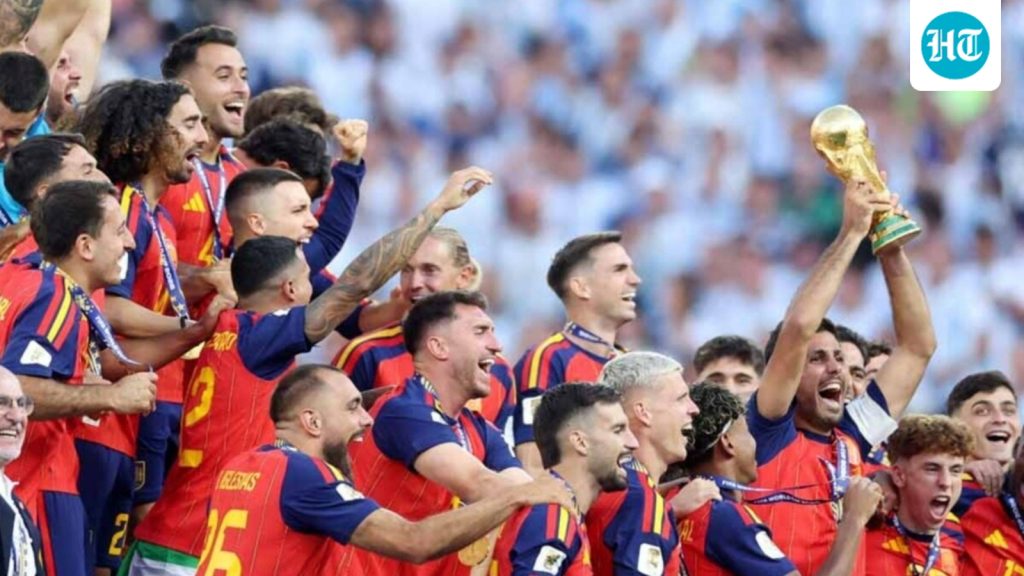
Netflix Lands Exclusive 2030 World Cup Streaming Rights in Spain and Andorra
Bharatmorning.com – Netflix will become the exclusive audiovisual home of the 2030 FIFA Men’s World Cup in Spain and Andorra, marking a major expansion of the streaming company’s live-sport ambitions. The deal, announced on October 13, 2026, covers every one of the tournament’s 104 matches as 48 national teams compete for football’s biggest prize.
The agreement gives Netflix a particularly significant role in Spain, which will be one of the principal host nations for the centenary edition of the competition. It will also represent Netflix’s first broadcast of a leading international men’s football tournament in the Spanish market.
Free Matches and Free-to-Air Coverage
Although Netflix has secured exclusive rights, the World Cup will not be entirely restricted to paid subscribers. One match on each matchday will be made available free of charge through the service, creating an accessible option for viewers who do not have a Netflix subscription.
In addition, Netflix plans to provide a separate package of rights to a national free-to-air broadcaster in Spain. That package will include every Spain match, both semi-finals and the final. The broadcaster selected for those games has not yet been announced, and further information on the arrangement is expected nearer to the tournament.
No equivalent free-to-air plan for Andorra was outlined when the agreement was revealed. Details surrounding availability, subscription options and the broader viewing experience are also still to come.
A Spanish-Focused Tournament Experience
Netflix intends to build programming around the matches rather than simply stream the games themselves. The platform has said it will produce pre-match, half-time and post-match coverage designed from a Spanish perspective. Matchdays will also feature a daily highlights and discussion programme, while a wider build-up is planned before the tournament begins.
The identities of presenters and commentators have not been confirmed. Netflix has also yet to disclose its production partners or explain whether special subscription packages will be introduced for the competition.
For viewers in Spain, the arrangement signals a shift in how one of the country’s most closely followed sporting events will be delivered. Major football tournaments have traditionally been closely tied to conventional television broadcasters, but streaming platforms are increasingly seeking rights to premium live events with broad international appeal.
Growing Relationship Between FIFA and Netflix
The 2030 agreement adds to Netflix’s growing business relationship with FIFA. The company already holds rights in the United States and Canada for the 2027 and 2031 FIFA Women’s World Cups, and the latest deal extends that partnership into the men’s game.
“Few events unite people like the World Cup,” Netflix Chief Content Officer Bela Bajaria said following the announcement.
Bajaria also reflected on watching Spain win the trophy during the 2026 World Cup, describing the prospect of bringing the next edition to audiences in Spain and Andorra as especially meaningful.
FIFA Secretary General Mattias Grafström also welcomed the partnership, highlighting the aim of creating a closer connection between supporters and the sport.
“Our shared ambition is to bring fans closer to the game,” Grafström said.
The financial terms of the rights deal have not been made public.
Netflix Continues Its Push Into Live Sport
Live programming has become an increasingly important part of Netflix’s offering. Its sports portfolio already includes NFL games, Major League Baseball, WWE events, boxing and mixed martial arts. Securing the 2030 World Cup rights in Spain and Andorra gives the platform one of the most prominent football properties in global sport.
The service has also developed a growing library of football-related documentaries and series. Titles such as Captains of the World, Beckham, LALIGA: All Access and The Figo Affair have helped establish a connection with football audiences beyond live broadcasts.
Netflix’s move into World Cup coverage could therefore combine live fixtures with original programming, tournament analysis and documentary-style storytelling, though the exact scale of those plans remains unconfirmed.
A Centenary World Cup Across Several Nations
The 2030 tournament will carry special historical significance as the 24th edition of the FIFA World Cup and the event’s centenary celebration. The inaugural competition took place in Uruguay in 1930, and FIFA has designed the 2030 edition to recognise that milestone.
Spain, Portugal and Morocco will serve as the main hosts. Uruguay, Argentina and Paraguay are each scheduled to stage one centenary match, linking the tournament with the nations associated with its earliest history. The competition is set to run from June 8 to July 21.
Netflix’s exclusive rights deal applies only to Spain and Andorra. It does not cover the other host countries, where separate media-rights arrangements will govern how supporters can watch the tournament.
During the 2026 World Cup, Spain’s matches were shown by TVE, while DAZN carried all 104 games via Mediapro’s pay-TV World Cup channel. The 2030 agreement introduces a different distribution model, with Netflix taking the central role while retaining planned access to selected free coverage.
As preparations for the centenary World Cup develop, further announcements are expected to clarify the Spanish broadcast partner, presentation team, pricing and programming schedule. For now, Netflix’s acquisition places one of sport’s largest global events at the centre of its evolving live-entertainment strategy.
Related Reading
Frequently Asked Questions
What is Netflix secures 2030 FIFA World Cup rights?
Netflix secures 2030 FIFA World Cup rights is the main topic of this guide. The article explains the context, practical details, and next steps readers should understand.
Why does Netflix secures 2030 FIFA World Cup rights matter?
Netflix secures 2030 FIFA World Cup rights matters because readers are looking for a useful answer, not just a short summary. Good content should match search intent and help them decide what to do next.