
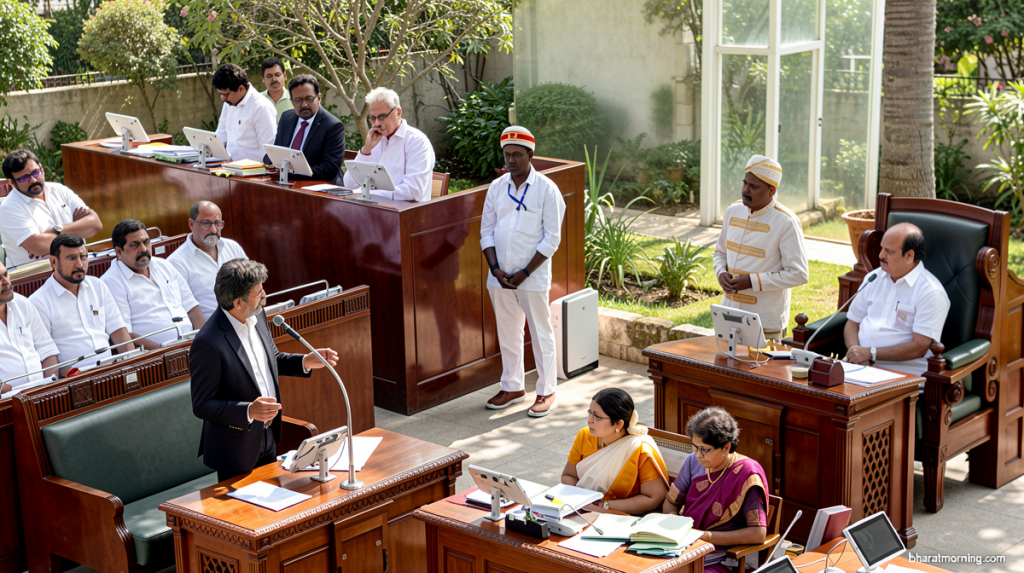
Tamil Nadu Assembly Erupts in Ruckus: DMK MLAs Evicted
Bharatmorning.com – The Tamil Nadu Assembly erupted in ruckus on Tuesday after a cluster of Dravida Munnetra Kazhagam legislators surged toward the Speaker’s dais, chanting slogans and demanding that remarks made by Chief Minister Vijay — remarks anchored in documents produced by the Enforcement Directorate — be struck from the official record. Speaker J. C. D. Prabhakar refused the expungement plea, and the standoff ended only when House marshals physically escorted the protesting MLAs out of the chamber.
What Sparked the Confrontation
The disturbance centred on a specific set of statements the chief minister had delivered in the House, statements that drew on material obtained by the Enforcement Directorate, the central government’s financial-crime investigation agency. The MLAs who took to the floor argued those remarks should be expunged — a parliamentary procedure by which words spoken in a legislature are formally deleted so they carry no evidentiary or political weight thereafter. The Speaker, after hearing the demand, declined to order expungement, a decision that immediately escalated the situation.
In Indian legislative practice, expungement is a relatively rare remedy, typically invoked when a member believes a remark was made under duress, contained a factual error that could mislead the public record, or was delivered while the member was not fully in command of their faculties. The Speaker retains discretion over whether to grant such a request, and refusal is not uncommon when the remarks are deemed deliberate and made in good faith.
Escalation and Removal
With the Speaker’s decision announced, the MLAs did not return to their seats. They continued sloganeering inside the chamber, effectively blocking the normal flow of business. The Law Minister stepped in to defend the chief minister’s original statement, arguing the remarks were accurate and warranted. Meanwhile, the Leader of the House, Sengottaiyan, called for disciplinary action against the legislators disrupting proceedings, pressing the Speaker to invoke the Assembly’s rules on order and decorum.
The Speaker subsequently directed the watch and ward staff to evict the DMK MLAs, who were removed from the Assembly by House marshals.
The watch and ward system — a pair of uniformed officers stationed at the chamber’s entrance — is a feature inherited from British parliamentary tradition. Their role is to maintain physical order within the House. When the Speaker issues a direction to remove a member, marshals carry out the removal. The episode in Chennai followed that established protocol: once the Speaker gave the order, marshals moved to separate the protesting legislators from the floor and guide them out.
Broader Context and Procedural Aftermath
Tamil Nadu’s legislature has, over recent years, become a frequent site of procedural confrontations between the ruling DMK and the opposition All India Anna Dravida Munnetra Kazhagam. Disruptions, walkouts, and demands for expungement have become recurring features of the state’s legislative calendar, often tied to high-stakes political narratives around corruption allegations, land disputes, and central-state friction. The Enforcement Directorate’s involvement adds a particular layer of sensitivity: ED files are treated with considerable caution in Indian courts and legislatures, and any parliamentary remark that cites ED material invites scrutiny over whether the documents were properly shared and whether the remarks accurately represent the investigation’s findings.
Once the marshals completed the removal, the Assembly resumed its scheduled business, though the episode left a visible mark on the day’s proceedings. No formal motion of censure or disciplinary notice was tabled immediately after the removal, though the Leader of the House’s earlier call for action suggests that procedural consequences could follow in subsequent sittings.
Tamil Nadu Assembly erupts in ruckus is the main topic of this guide. The article explains the context, practical details, and next steps readers should understand. Tamil Nadu Assembly erupts in ruckus matters because readers are looking for a useful answer, not just a short summary. Good content should match search intent and help them decide what to do next.Related Reading
Frequently Asked Questions
What is Tamil Nadu Assembly erupts in ruckus?
Why does Tamil Nadu Assembly erupts in ruckus matter?