
A Kolkata Heritage Home Where Family History Meets Vintage Craftsmanship
Bharatmorning.com – In Kolkata, a red-brick residence that has stood for 117 years offers a vivid example of how a family home can hold far more than furniture and photographs. For Amritendu Roy, the colonial-era property is a living archive of family memory, restoration work and cultural traditions that have grown together over generations.
Built in a colonial style by British engineers, the house has remained a defining part of Roy’s life. He was born and raised there, and its original architectural details, inherited objects and timeworn spaces continue to shape his connection with it. His grandfather purchased the home in 1943, beginning a family stewardship that has retained its historic atmosphere while keeping it functional as a home.
A Home Shaped by Several Traditions
The residence reflects a meeting of Bengali heritage, Parsi influence and colonial design. That blend became especially meaningful after Roy married his Parsi wife, bringing two distinct family traditions into the same household. Rather than treating the building as a static relic, the family’s approach allows its different cultural layers to coexist in everyday life.
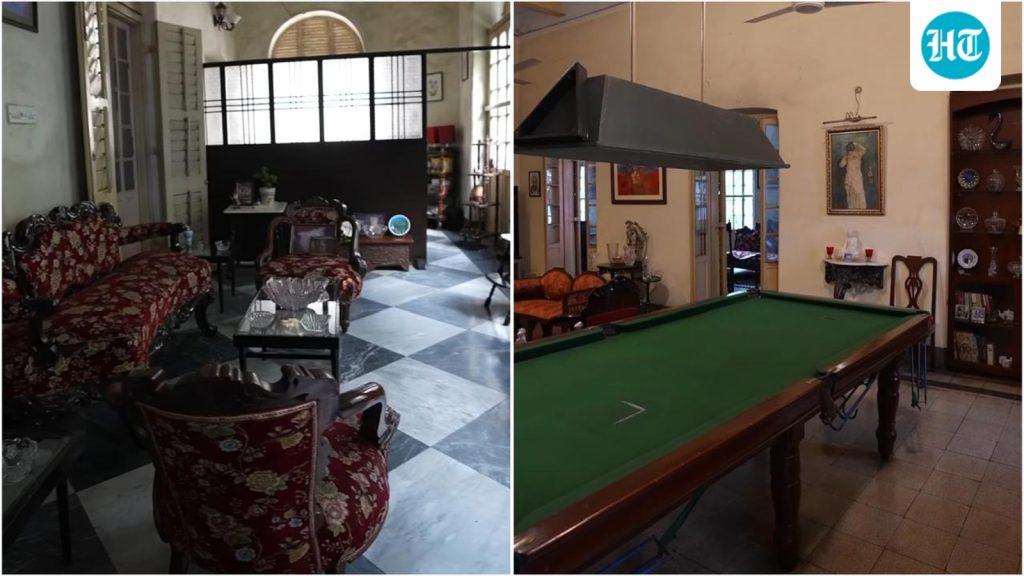
With roughly 12 rooms, the house contains spaces that carry their own histories. The formal sitting room is furnished with pieces passed down through the family, including a Burmese sideboard believed to be about 150 years old. A pool table contributes to its period character, while a Chinese sideboard, estimated to date back between 100 and 150 years, adds another chapter to the collection.
“The furniture you see here are inherited from family,” Amritendu explains.
These objects are not presented merely as decorative antiques. Their importance comes from the personal histories attached to them, having remained within the family across generations. The home’s interiors show how preservation can be intimate: a sideboard, staircase or room may be valuable because it carries a memory as much as because of its age.
Details of Colonial-Era Design
One of the home’s defining features is its wooden staircase, strengthened with iron beams. It remains a striking reminder of the material skill involved in constructing such residences more than a century ago. The broad veranda is another key element. In an earlier era, the English referred to this open-fronted space as a balcony, and it continues to convey the scale and grace of the house’s original design.
An old outhouse, initially used as the kitchen, still retains its historic chimneys. Elsewhere, the main bedroom and a guest room reveal the practical side of life in a heritage property. The guest room also serves as Roy’s office and a casual sitting area, demonstrating that the house is not frozen in time. It remains a working domestic space, adapted to present-day routines without discarding its identity.
Maintaining a house of this age involves a different way of looking at old materials. Weathered wood, aged brickwork and inherited fixtures are not automatically replaced; they can be repaired and retained when possible. That outlook is central to Roy’s wider interest in restoration.
From Furniture Restoration to Classic Cars
Roy’s enthusiasm for reviving older objects extends well beyond the rooms of his home. He restores houses, furniture and automobiles, treating each project as an opportunity to preserve something with a story.
“I restore house, I restore furniture and I restore old cars also,” he says.
His garage contains some of the most distinctive examples of this passion. The collection includes a 1974 Ford Mustang, a 1964 Ford Anglia and a Morris Minor convertible. The Anglia is widely recognised by many viewers as the vehicle associated with the Harry Potter films, while the Mustang and Morris Minor represent different eras of automotive design.
“This is a 1974 Ford Mustang,” he says while introducing one of the collection’s prized cars.
He also refers to the Ford Anglia as “the Harry Potter car,” before showing the Morris Minor convertible. Each vehicle reflects the patience involved in keeping classic cars roadworthy and preserving their original appeal. Like a heritage home, an old automobile requires attention to detail and an appreciation of what makes it distinct from newer models.
Roy has displayed his success in vintage and classic-car competitions in a bar he created himself. Instead of functioning primarily as a place for bottles, the space showcases trophies earned through car shows.
“I made this bar,” Amritendu explains, adding that it holds “mainly all the trophies I won for the vintage car and classic car shows.”
Keeping Stories in Motion
The appeal of Roy’s home lies not only in its age or in the rarity of individual antiques. Its significance comes from the way its rooms, objects and vehicles connect family experience with a broader love for the past. Bengali traditions, Parsi heritage and colonial craftsmanship all find a place within the same red-brick structure.
For visitors, the house offers a reminder that heritage is not limited to monuments or museums. It can survive in a family staircase, a carefully restored sideboard, an old kitchen chimney or a vintage car brought back to life. Preservation becomes most meaningful when it allows objects and places to remain part of lived experience.
Roy’s 117-year-old Kolkata home shows that history is sustained through care. By restoring the building, retaining inherited furniture and maintaining classic cars, he keeps the stories behind them active for the next generation.
Related Reading
Frequently Asked Questions
What is Step inside 117 year old Kolkata?
Step inside 117 year old Kolkata is the main topic of this guide. The article explains the context, practical details, and next steps readers should understand.
Why does Step inside 117 year old Kolkata matter?
Step inside 117 year old Kolkata matters because readers are looking for a useful answer, not just a short summary. Good content should match search intent and help them decide what to do next.