
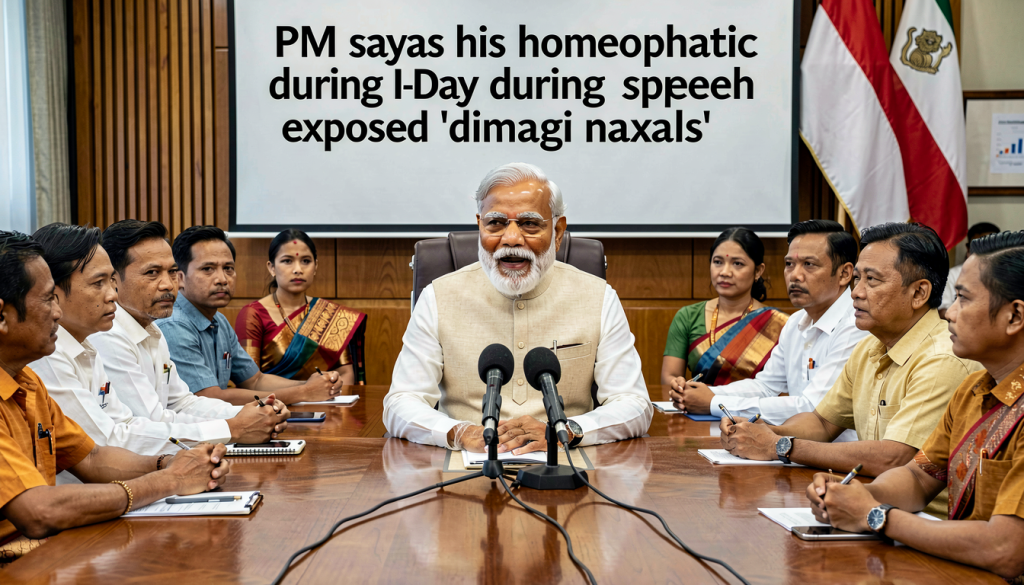
PM Modi’s Homeopathic Dose Exposed Dimagi Naxals
Bharatmorning.com – PM Modi says his homeopathic dose delivered during the Independence Day address had already exposed every “dimaagi naxal” lurking in Indian politics. Speaking at the centenary celebration of Delhi University’s Sree Ram College of Commerce (SRCC) on Saturday, the Prime Minister revisited the metaphor he had first deployed from the Red Fort weeks earlier, telling the gathered alumni and faculty that the tiny pellet of rhetoric had triggered a full systemic response. The SRCC ceremony, marking a century of the institution founded in 1924, thus became the stage for what was widely read as a second, sharper volley aimed at opposition leaders.
The Metaphor and Its Political Target
The phrase “dimaagi naxal” — Hindi for something like “intellectual insurgent” — had ignited a firestorm after Modi used it in his August 15 speech watched by hundreds of millions across television and digital platforms. At SRCC, PM Modi says his homeopathic intervention was never meant to create a condition but merely to reveal one already present. He told the crowd that the moment he administered the dose, every dimaagi naxal had been forced into the open, and the public was now witnessing the true colours of those nurturing the ailment.
“Jaise hi maine dimaagi naxal wali homepathy ki goli di, sare dimaagi naxal nikal nikal ke bahar aanay lage aur jo is bimari ko badhawa de rahe hain ab janta unka bhi asli rang dekh rahi hai.”
The analogy operates on a specific cultural frequency. Homeopathic remedies remain widely consumed across India, and the image of a sugar pellet producing a dramatic therapeutic effect is familiar to a broad cross-section of voters. By casting his words as such a pellet, Modi positioned himself as a diagnostician exposing a pre-existing pathology rather than authoring one. Critics, in his framing, were not reacting to an insult but convalescing from a condition that had been present all along.
Why the SRCC Setting Sharpened the Point
Transplanting the jab from a national-ceremony context into a university centenary carries its own symbolic weight. SRCC has produced generations of economists, journalists, and public servants since its founding in 1924. Addressing its alumni while deploying language that questions the intellectual integrity of political opponents created a tension commentators flagged within hours of the event. The choice to deliver the key passage in Hindi rather than English further sharpened the point: Hindi carries the register of the common voter, and phrases like “asli rang dekh rahi hai” land with a colloquial punch that English equivalents tend to flatten.
For opposition parties, the repeated deployment of the phrase creates a strategic dilemma. Ignoring it risks conceding the point; pushing back risks validating the framing in which dissent becomes evidence of the disease Modi claims to have diagnosed. The SRCC venue compounds the difficulty because a forceful rebuttal at a centenary of an academic institution risks appearing tone-deaf to the institutional occasion.
PM Modi says his homeopathic remark was never intended as a personal attack but as a diagnostic tool, and that the public’s subsequent reaction confirmed the diagnosis. Whether that framing persuades beyond the ruling party’s base remains the central question the episode leaves unresolved.
FAQ
What did PM Modi mean by calling his remark a “homeopathic dose”? He compared his use of the phrase “dimaagi naxal” to a tiny homeopathic pellet: a minimal intervention that, in his telling, triggered a large-scale diagnostic response, exposing those he labelled intellectual insurgents.
Where and when did the SRCC remarks take place? The comments came during the centenary celebration of Sree Ram College of Commerce, Delhi University, held on a Saturday following his August 15 Independence Day address from the Red Fort.
Why did the phrase generate controversy? Opposition leaders and commentators read “dimaagi naxal” as branding political dissent as a form of mental illness, an accusation of authoritarian overreach that migrated quickly across social media and editorial pages.