
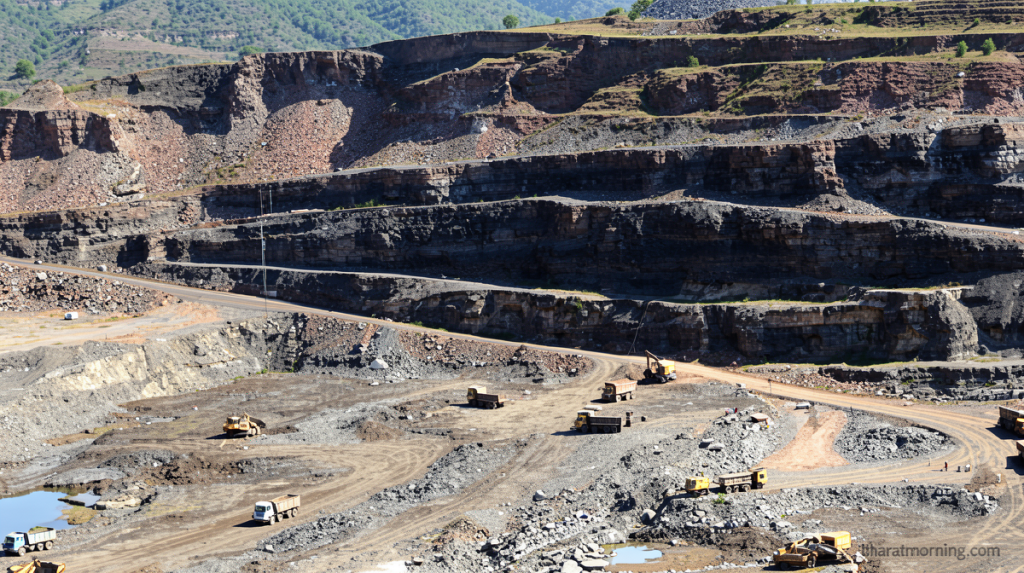
The Quiet Revolution Underground: How Intelligence Is Rewiring the World’s Oldest Industry
Bharatmorning.com – The industry that once defined itself by tonnage moved and depth reached is being quietly redefined by something far harder to see from the surface: software. Autonomous haul trucks, machine-learning-driven maintenance algorithms, and remotely piloted drilling rigs are no longer laboratory curiosities. They are running in production across continents, reshaping how ore gets from the ground to the processing plant. For India’s mining sector, the question is no longer whether these tools work. It is whether fragmented digital pilots can be stitched into coherent, enterprise-wide operating systems capable of scaling across the country’s wildly varied geological and operational terrain.
Global Autonomy Has Crossed the Threshold
In Western Australia’s Pilbara region, Rio Tinto’s iron-ore operations now run roughly 90% of their haul-truck fleet without a human in the cab. Forty autonomous production drills operate across seven sites, and the company’s AutoHaul railway links 18 mines along nearly 2,000 kilometres of mainline rail. All of this is supervised from a control centre in Perth, approximately 1,500 kilometres from the pits themselves. The distance between the operator and the machine has become a non-issue.
Chile’s copper belt is following a parallel trajectory. At BHP’s Escondida mine, the Escondida Norte pit fields 33 autonomous trucks alongside 11 autonomous drills. That autonomous zone pushes more than 350,000 tonnes of material through its daily cycle and now represents roughly 30% of the mine’s total output. Over 5,000 workers have completed training programmes tied to the technology transition, underscoring that the shift is as much a workforce re-skilling exercise as an engineering one.
In Brazil, Vale’s Northern System currently deploys 14 autonomous haul trucks, with a stated plan to expand the fleet to approximately 90 units by 2028. The company attributes gains of up to 15% in operating performance and fuel-consumption reductions of up to 7.5% to autonomous haulage programmes already running elsewhere in its portfolio.
India’s Problem Is Different — and Harder
No Indian operator yet fields autonomous truck fleets at the scale visible in Pilbara or the Atacama. But that comparison misses the point. India’s mining geography spans enormous opencast coal seams, deep underground zinc workings, and vertically integrated iron-ore-to-steel value chains. A driverless 400-tonne haul truck, transformative in a flat Pilbara pit, may be the wrong first tool for a narrow underground drift where the critical risk is a vehicle closing on a worker.
The most consequential technologies for an Indian underground mine might instead be a drill piloted from the surface, a proximity-detection system that halts equipment before it reaches a pedestrian, or a predictive-maintenance algorithm that schedules component replacement before a failure strands a crew hundreds of metres below grade.
Hindustan Zinc: From Pilot Projects to an Operating Model
The company’s FY 2026 Annual Report frames its digital strategy not as a catalogue of standalone IT projects but as what it calls HZL 2.0 — a technology-led operating model spanning mines and smelters. The toolkit includes AI and machine-learning analytics, industrial IoT sensor networks, computer-vision systems, tele-remote drilling, predictive maintenance, and broader remote-operations capabilities.
Several deployments have already produced quantifiable operational effects:
An AI-driven thermal and optical monitoring system watching high-load switchyard equipment logged a reported 172 hours of avoided downtime across the smelter network. A separate AI-based pallet grate-bar monitoring programme cut breakdown frequency by more than 20%. An integrated machine-learning system governing autonomous chemical dosing trimmed chemical-consumption norms by approximately 4%.
Underground Safety as the Primary Use Case
Below grade, the business case for digitalisation is inseparable from worker safety. At the Sindesar Khurd mine, the company recorded what it describes as the world’s first tele-remote raise-bore operation — a drilling task executed from the surface rather than by a crew in the borehole. Collision-avoidance technology at the same site now covers 11 low-profile dump trucks and 19 load-haul-dump vehicles, fusing equipment-mounted sensors, pedestrian identification tags, and proximity-detection logic into a continuous safety envelope.
Exploration Gets a Data-Driven Upgrade
The same intelligence push extends to the exploration phase. Hindustan Zinc’s exploration division integrates drone-based magnetic surveys with LiDAR, borehole electromagnetic surveys, hyperspectral imaging, satellite remote sensing, three-dimensional geological modelling, and AI/ML routines for target generation and drilling optimisation. Sharper geological intelligence means fewer exploratory holes drilled into empty ground and more disciplined allocation of capital toward the most probable ore bodies.
Tata Steel: Scale of the Model Portfolio
At the steel end of the value chain, Tata Steel reported more than 558 distinct AI models in operation during FY 2024-25. Their scope spans process control, predictive and prescriptive maintenance, procurement analytics, and boulder detection at mine sites. The sheer number of models signals that the company treats machine learning not as a single initiative but as a distributed capability threaded through every operational function.
What Comes Next
The global technology question has shifted. It is no longer whether an autonomous truck can haul ore or whether a neural network can spot a boulder before it cracks a crusher jaw. The question now is whether drilling, haulage, maintenance, processing, and logistics can be woven into a single operating system that learns, adapts, and continuously improves. For Indian miners navigating a landscape of coal, zinc, iron ore, and steel, the answer will determine whether the next decade of productivity gains arrives as isolated digital experiments or as a durable, enterprise-wide capability.
Related Reading
Frequently Asked Questions
What is Mining gets smarter?
Mining gets smarter is the main topic of this guide. The article explains the context, practical details, and next steps readers should understand.
Why does Mining gets smarter matter?
Mining gets smarter matters because readers are looking for a useful answer, not just a short summary. Good content should match search intent and help them decide what to do next.