
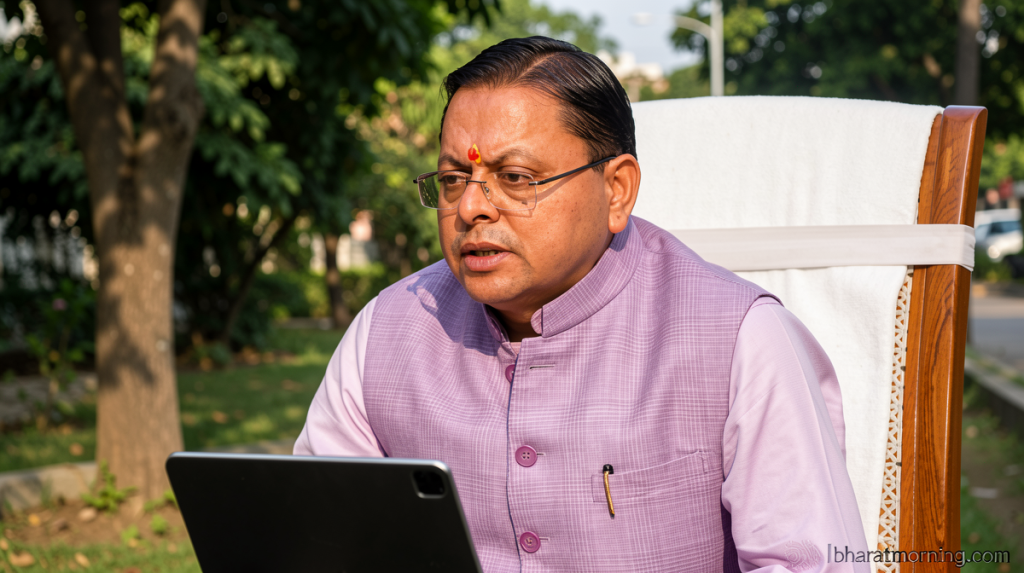
Uttarakhand CM Pushkar Singh Dhami Turns a Cup of Tea Into a Political Statement Against Caste-Based Discourse
Bharatmorning.com – In a pointed rebuttal to Congress leader Rahul Gandhi’s recent comments on caste, Uttarakhand Chief Minister Pushkar Singh Dhami used an unscripted moment over a shared drink to argue that Indian politics has grown dangerously fixated on reading caste into every human encounter. Speaking casually to residents in the hill town of Khatima, Dhami framed his intervention not as a formal press briefing but as a lived observation: he had just sat among locals, accepted tea poured into throwaway cups, and felt what he described as genuine warmth without a single trace of caste-based division in the room.
The Tea-Cup Metaphor
Dhami’s central image was deliberately simple. He acknowledged that the cup itself was disposable, yet warned that political thinking must not become equally disposable — reduced to the reflex of scanning every social interaction for markers of hierarchy or discrimination. The remark was aimed squarely at what he characterised as the “height of narrow-minded politics,” a phrase he deployed while still seated among the residents who had gathered for the informal exchange.
“The cup may be disposable, but our thinking should not be so disposable that we start looking for caste and politics even in a cup of tea,” Dhami said.
The choice of setting mattered. By anchoring his critique to an act as mundane as sharing a hot beverage in a mountain town, Dhami sought to ground his argument in sensory experience — the taste of the tea, the affection in the residents’ faces — rather than in abstract policy language. He stressed that during the interaction he registered no caste marker whatsoever, and that the absence of division was itself the point.
Uttarakhand’s Social Fabric as a Political Argument
Dhami went on to invoke the state’s long-standing cultural traditions of brotherhood, mutual affection, and communal living. In his framing, these values are not relics but living norms that should shape how public life and political debate unfold, especially when individuals from varied backgrounds share an ordinary space. He positioned Uttarakhand’s social architecture as a counter-model to what he called the polarising impulse embedded in much of national political rhetoric.
The chief minister argued that repeated attempts to identify caste or partisan fault lines within routine social contact risk manufacturing divisions that do not organically exist in everyday hill-town life. Political leadership, he contended, should be oriented toward consolidating social cohesion rather than amplifying fractures.
The Broader National Debate
The exchange lands amid a sustained national conversation over caste representation, reservation policy, and the role of identity categories in democratic politics. Major parties routinely foreground questions of social justice and equitable representation in their platforms, and leaders across the spectrum have, at various points, drawn attention to caste-based discrimination in employment, education, and public life. Dhami did not dispute the existence of caste discrimination as a historical and present-day reality; his objection was narrower and more procedural. He maintained that such issues, while legitimate subjects of policy, should not be converted into a universal lens through which every interpersonal interaction is parsed.
In practical terms, his intervention draws a line between two kinds of political speech: one that addresses structural inequality through legislation, welfare design, and institutional reform, and another that, in his view, instrumentalises caste as a perpetual mobilisation tool, inserting it into contexts where it plays no operative role. The tea-cup episode became, in his telling, a microcosm of that distinction.
Direct Engagement Beyond Administrative Channels
Dhami also used the occasion to articulate a broader philosophy of governance. Interactions of the kind he described in Khatima — informal, unmediated, stripped of bureaucratic protocol — offer, he said, a window into residents’ lived experiences that no survey or administrative report can replicate. He framed such encounters as essential to a functioning democracy in which leaders remain tethered to the people they serve rather than insulated within institutional perimeters.
He reiterated that political disagreement is an inherent feature of democratic discourse and need not be suppressed. What he opposed, however, was the specific tactic of reducing every social encounter to a caste equation, arguing that such a reduction does not advance the country’s collective interests but instead entrenches the very divisions a healthy polity must work to dissolve.
Implications for Hill-State Politics
For Uttarakhand, a state whose demographic composition and cultural history differ markedly from the plains regions where caste politics has historically been most acute, Dhami’s remarks carry particular weight. The chief minister’s insistence on brotherhood and shared social responsibility as governing norms positions the state’s political culture as a deliberate alternative to identity-driven mobilisation. Whether that framing resonates beyond the state’s borders, or whether national-level caste debates continue to set the terms of political argument regardless of regional context, remains an open question. What is clear from the Khatima episode is that Dhami intends to keep the question alive — one cup of tea at a time.
Related Reading
Frequently Asked Questions
What is Dhami takes swipe at Rahul Gandhi?
Dhami takes swipe at Rahul Gandhi is the main topic of this guide. The article explains the context, practical details, and next steps readers should understand.
Why does Dhami takes swipe at Rahul Gandhi matter?
Dhami takes swipe at Rahul Gandhi matters because readers are looking for a useful answer, not just a short summary. Good content should match search intent and help them decide what to do next.