
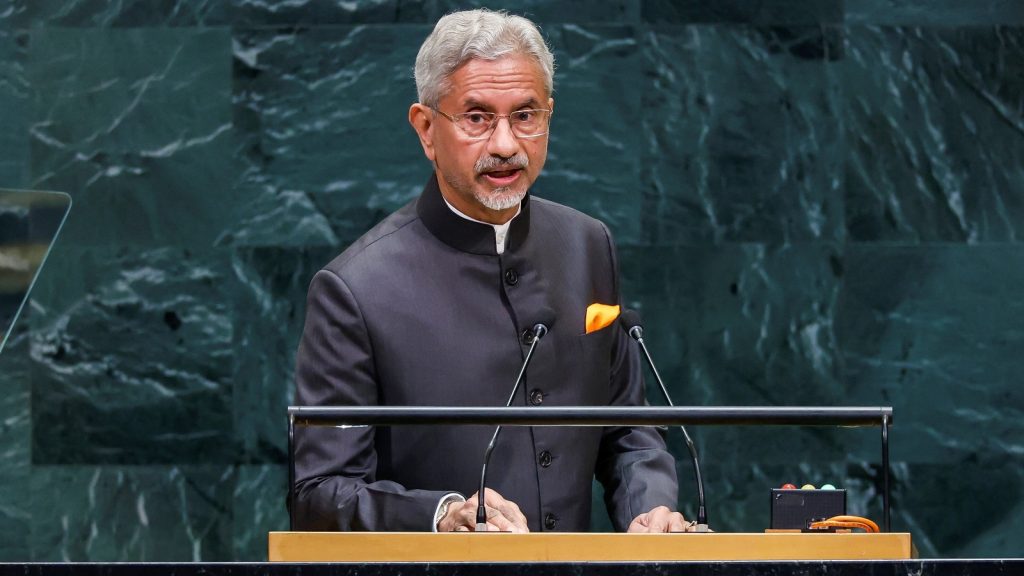
Jaishankar Warns of Global Costs as Conflicts Deepen
Bharatmorning.com – External affairs minister S Jaishankar has urged the United Nations General Assembly to acknowledge the wider consequences of armed conflicts, saying nations with no direct role in those crises are still bearing serious economic and humanitarian costs.
Speaking at the UNGA, Jaishankar recalled an earlier observation by Prime Minister Narendra Modi that countries geographically distant from conflict zones can nevertheless be harmed by their fallout. He said the present global environment demonstrates why that concern has become increasingly urgent.
“Countries far from conflicts are being penalised for no fault of theirs. Those most impacted often have the least say,” Jaishankar said.
His remarks drew attention to a persistent imbalance in international decision-making: countries affected by disrupted trade, higher energy costs and instability in major sea routes may have limited influence over the disputes that create those pressures.
Concern Over Escalation in West Asia
Jaishankar highlighted the continuing unrest in West Asia, with particular concern over the conflict in the Gulf. He said the new confrontation was worsening conditions in a region already facing severe tensions and uncertainty.
“This year, we are witnessing a conflict in the Gulf, one that is exacerbating an already difficult situation. We remain deeply concerned over continuing hostilities.”
The Gulf has particular importance for global energy supplies, commercial shipping and trade connections between Asia, Europe and other regions. Instability there can affect markets and supply chains far beyond the countries directly involved in a conflict.
For India, developments in the region are especially significant because of longstanding economic, energy and people-to-people links with West Asia. A sustained disruption to transport routes or energy flows can have broader consequences for import-dependent economies and international commerce.
Shipping Safety and Energy Flows
The minister also raised alarm over attacks on commercial vessels and seafarers amid strikes in the Strait of Hormuz. The waterway is a vital international maritime passage, and threats to ships using it create risks for crews, cargo movement and the wider trading system.
Jaishankar said attacks on vessels travelling through international waters could not be accepted.
“India calls upon all parties to exercise restraint, de-escalate tensions, ensure protection of civilians, and uninterrupted flow of energy and commerce,” he said.
The appeal combines several priorities: preventing further military escalation, protecting non-combatants, safeguarding maritime personnel and maintaining access to essential trade routes. In periods of conflict, disruptions at strategic chokepoints can quickly affect freight schedules, insurance costs and the movement of commodities.
Commercial shipping depends on predictable and secure navigation. When vessels or crews face threats, shipping companies may alter routes, delay travel or take additional security measures. Such decisions can add pressure to an already fragile global supply network.
A Call for Greater Responsibility
Jaishankar’s address placed the focus on countries that are not parties to conflicts but still experience their consequences. His argument was that international responses should take account of the interests of a broader range of nations, particularly those facing the costs of instability without having a meaningful voice in decisions that shape events.
The statement also reflected India’s repeated emphasis on dialogue, restraint and diplomacy in dealing with international crises. By calling for de-escalation, Jaishankar stressed the need to limit violence while protecting civilians and preserving the movement of energy and goods.
At the United Nations, such appeals carry added weight because conflicts frequently have effects that extend beyond national borders. Wars can reshape trade routes, strain food and energy markets, displace people and increase uncertainty for governments and businesses across continents.
Jaishankar’s message was therefore directed not only at parties engaged in hostilities, but also at the wider international community. His call to confront the “true state of affairs” underlined the view that the costs of conflict are distributed unevenly, often reaching countries that are distant from the battlefield yet deeply exposed to its economic and social repercussions.
As tensions continue in the Gulf and elsewhere, India’s position remains centred on restraint, civilian protection and the uninterrupted functioning of international trade and energy networks. The minister’s intervention at the UNGA reinforced the argument that global stability requires attention to the interests of every country affected by conflict, not only those directly involved in it.
Related Reading
Frequently Asked Questions
What is Countries far from conflicts being penalised?
Countries far from conflicts being penalised is the main topic of this guide. The article explains the context, practical details, and next steps readers should understand.
Why does Countries far from conflicts being penalised matter?
Countries far from conflicts being penalised matters because readers are looking for a useful answer, not just a short summary. Good content should match search intent and help them decide what to do next.