
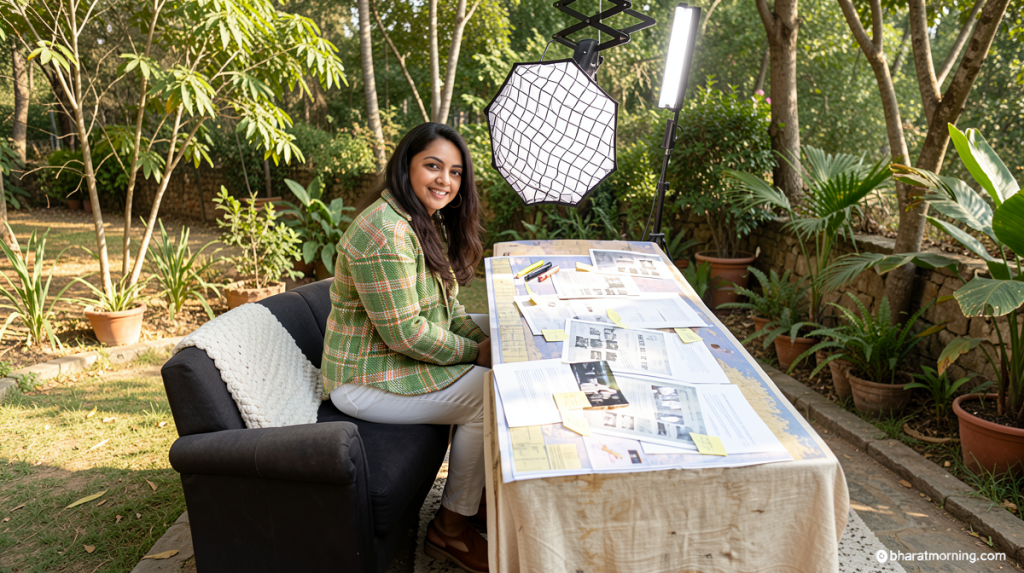
Bengaluru Founder Spent ₹1.5 Lakh on First YouTube Video
Bharatmorning.com – Bengaluru founder shares why she spent ₹1.5 lakh on her very first YouTube video, a decision that ended an 18-month cycle of hesitation and produced a polished 20-minute financial explainer. Chandralekha MR, a Bengaluru-based entrepreneur, explained the reasoning behind the high-cost debut in a LinkedIn post, framing the expenditure not as vanity but as a deliberate mechanism to break through prolonged indecision.
Why She Chose a High-Production Debut
Chandralekha MR described the internal conflict that preceded the spend. After waiting 18 months to launch a YouTube channel, she ultimately allocated ₹1.5 lakh to a single video rather than defaulting to a low-budget, unedited clip. The result was a 20-minute piece examining why India keeps losing to the dollar, produced over one month by a dedicated team.
“I waited 18 months to start YouTube, then spent ₹1.5 lakh on video one. My first long-form video has taken one month and a team to produce. It is a 20-minute video on why India keeps losing to the dollar. Could we have opened a camera, spoken for 20 minutes, and uploaded it at a much lower cost? Obviously,” she wrote on LinkedIn.
The Bengaluru founder shares why she spent that amount by pointing to the complexity of translating finance into engaging video. A superficial take, she argued, would reduce the topic to “a longer Instagram Reel,” and viewers would disengage almost immediately.
“That meant we had to work on the research, script, examples, visual treatment, edit, and overall pace together. A weak decision in one layer could make a technically correct video feel boring.”
She was candid about the fact that replicating the spend across future uploads would be impractical. The investment, in her framing, served a singular purpose: forcing the team to learn what long-form finance production demands and collapsing the year-and-a-half loop of perpetual postponement.
“Spending ₹1.5 lakh on the first video is probably not a sensible template for the next 20. I know that. For this one, the investment forced us to learn what long-form finance production demands. It also ended the one-and-a-half-year loop of saying, ‘I want to start YouTube.'”
Addressing the broader pattern among founders who wait for certainty before entering a new format, she noted that she had no guarantee the channel would succeed. What she did have was a topic she cared about, a willing team, and what she called “a very expensive commitment sitting on the calendar.”
“Founders often wait for certainty before entering a new format. I had no certainty that YouTube would work for me. I had a topic I cared about, a team willing to make it, and a very expensive commitment sitting on the calendar.”
Commenters on the post echoed the sentiment. One wrote that putting “serious skin in the game” was the smartest way to kill the 18-month hesitation, while another asked why she did not instead allocate the ₹1.5 lakh to YouTube ads. Her reply: organic depth earns trust in a way paid reach does not, and her goal was to build production muscle, not buy short-term impressions.
FAQ: Practical Takeaways for New Creators
Is spending heavily on a first video a repeatable strategy?
Chandralekha MR explicitly cautioned against treating the ₹1.5 lakh outlay as a template for subsequent uploads. She described it as a one-time intervention designed to overcome hesitation and establish production standards, not an ongoing budget line.
What made the 20-minute format necessary for her topic?
Finance content, she explained, requires viewers to follow a chain of ideas before they can evaluate or act on them. A short-form clip would truncate the argument and leave the audience without the context needed to stay engaged, effectively turning the video into a longer version of a social-media reel.
How does she plan to iterate after the debut?
She stated that the video’s audience performance will dictate what to improve next, and that the month of production already revealed where the operational work lives. The next steps, in her words, will be guided by viewer feedback rather than by a pre-set production schedule.