
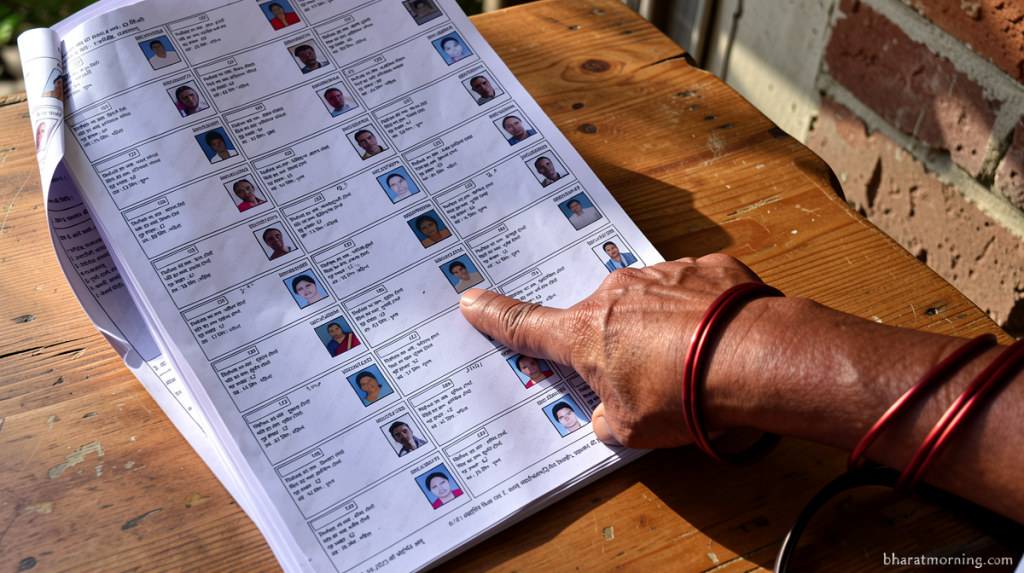
Delhi’s Voter Roll Sheds Nearly 4.8 Million Names, Tightening the Gender Balance
Bharatmorning.com – The Special Intensive Revision of Delhi’s electoral rolls has produced one of the most dramatic reshufflings of the city’s voter register in recent memory. Nearly 4.76 million entries were struck from the draft rolls, and in the process the long-standing numerical imbalance between male and female electors was compressed sharply. Data published on Monday by the Chief Electoral Officer’s office in Delhi shows the gender gap falling from roughly 913,000 voters to just over 224,000 — a contraction that reflects the disproportionate removal of male names during the exercise.
Scale of the Deletions
The draft roll now carries 9,753,577 electors, down from the 14,510,299 names that appeared on the rolls as of June 20. That represents a 32.8 percent reduction in total electoral entries across the capital. Of the 4,756,722 individuals excluded, 2.72 million were men and 2.03 million were women. In percentage terms, the male electorate contracted by 35 percent while the female electorate fell by 29.9 percent compared with the pre-revision rolls.
Before the revision, Delhi’s rolls listed 7,711,132 male voters (53.1 percent of the electorate) and 6,798,142 female voters (46.9 percent), alongside 1,024 third-gender electors. After the purge, the draft roll shows 4,988,993 male electors (51.2 percent) and 4,764,137 female electors (48.8 percent), with 447 third-gender entries remaining.
How the Enumeration Unfolded
Booth-level officers deployed across 13,033 polling stations collected 9.75 million enumeration forms between June 30 and August 17, reaching 67.22 percent of the registered electorate. The remaining 4.76 million electors — those who did not submit forms or could not be verified — were dropped from the draft roll.
The excluded names break down into several categories. Approximately 4.33 million were classified as permanently shifted, absent, or falling under an “others” bucket. An additional 282,412 were identified as deceased, and 141,535 were flagged as duplicates or voters enrolled at multiple locations.
The “absent, shifted or others” grouping encompasses voters who had migrated to another state or Union territory, could not be located during field verification, failed to return their enumeration forms by the August 17 deadline, or simply declined to register as electors for personal reasons.
Every one of Delhi’s 70 Assembly constituencies saw a decline in electoral entries, with constituency-level reductions ranging from 16.5 percent to 47.8 percent.
Claims, Objections, and Corrections
The Chief Electoral Officer’s office emphasised that exclusion from the draft roll does not extinguish a genuine voter’s right to enrolment. Electors who missed the June 30–August 17 window can petition for inclusion during the claims-and-objections period, which opened on Monday and runs through September 30. Applicants must file Form 6 accompanied by the prescribed declaration.
The same window permits voters to correct their particulars, while citizens and political parties may challenge wrongful inclusions. Form 7 handles objections and deletion requests; Form 8 covers residence shifting and corrections to electoral particulars.
The final electoral roll is scheduled for publication on November 4.
Political Reactions
The Aam Aadmi Party moved quickly to cast the exercise in a negative light. AAP chief Arvind Kejriwal took to X to describe what he called a “large-scale deletion of voters,” questioning the rationale behind the revision.
“Out of 1.5 crore voters, the names of 47 lakh voters are missing. The government of India is unnecessarily worried about the population. Through SIR, the Election Commission will reduce our country’s population from 140 crore to 50 crore,” Kejriwal wrote on X.
The Delhi CEO’s office was approached for a response to Kejriwal’s remarks but had not replied as of publication.
Harsh Malhotra, Delhi unit chief of the Bharatiya Janata Party, pushed back against the AAP critique. He suggested the former chief minister was raising alarm because supporters who had been enrolled at two or three locations simultaneously were now being consolidated into a single entry.
“If Kejriwal believes that any genuine and eligible voter has been left out despite submitting the form, he should present such cases before ECI,” Malhotra said.
What the Revision Means for Delhi’s Electoral Landscape
The SIR is a periodic rationalisation exercise mandated by the Election Commission to purge stale, duplicate, and deceased entries from voter rolls. In a fast-growing metropolis like Delhi, where migration, urbanisation, and repeated relocations generate large numbers of phantom entries, such cleanups are routine but politically sensitive. A 32.8 percent contraction in a single cycle is unusually steep and will reshape constituency arithmetic, booth allocation, and campaign logistics ahead of the next general or Assembly election.
The narrowing of the gender gap, while statistically notable, is a by-product of differential migration and verification rates rather than a deliberate policy outcome. Men, who historically constituted a larger share of Delhi’s electorate, were removed at a higher absolute and proportional rate during this cycle. Whether the gap continues to close in subsequent revisions will depend on future migration patterns and the success rate of the claims-and-objections process currently underway.
With the final roll due on November 4, political parties and independent candidates will have roughly six weeks to scrutinise the published list, file any remaining objections, and recalibrate their ground-game strategies around the revised booth geography that accompanies the rationalised rolls.
Related Reading
Frequently Asked Questions
What is Delhi SIR narrows gender gap as voter?
Delhi SIR narrows gender gap as voter is the main topic of this guide. The article explains the context, practical details, and next steps readers should understand.
Why does Delhi SIR narrows gender gap as voter matter?
Delhi SIR narrows gender gap as voter matters because readers are looking for a useful answer, not just a short summary. Good content should match search intent and help them decide what to do next.