
Supreme Court Clears Path as Lucknow Municipal Corporation Tackles Court-Complex Encroachment
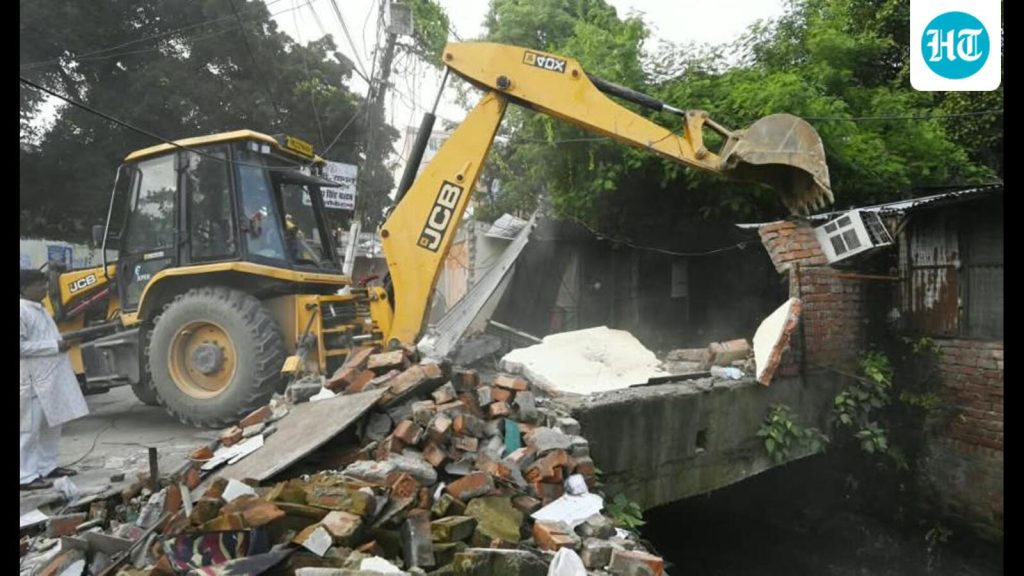
Bharatmorning.com – The Supreme Court’s recent refusal to entertain a petition filed by local advocates has unlocked a long-stalled municipal operation in Lucknow. On Sunday evening, civic workers brought heavy machinery to the perimeter of the district court complex and tore down 57 structures that authorities classify as illegal chambers. The operation concluded without a single protest, confrontation, or disruption to judicial proceedings — a marked contrast to the earlier demolition drive that had drawn vocal opposition from the bar.
Operational Timeline
A joint police-and-administration contingent arrived at the site at approximately 4:30 p.m. on Sunday. They were followed shortly after by a Lucknow Municipal Corporation (LMC) convoy carrying eight bulldozers and assorted heavy vehicles. Municipal officials first ensured that the electrical supply feeding the affected stretch was cut off. Demolition commenced at 5:10 p.m. and ran for roughly 75 minutes before the last structure in the batch was reduced to rubble.
The operation had originally been slated for the morning. LMC had initially scheduled the drive for around 10:45 a.m. on Sunday, with plans to deploy approximately four heavy earth movers. However, a VIP movement through the city disrupted the police deployment plan, forcing the civic body to postpone the exercise until evening. Officials confirmed the delay was purely logistical and unrelated to any legal hold-up.
The Judicial Backdrop
The renewed demolition follows a sequence of court orders that began with the Allahabad High Court directing the municipal corporation to clear encroachments on government land adjacent to the district court. Acting on those directions, LMC carried out an earlier demolition drive on May 17. That first wave triggered immediate protests from practicing advocates who occupied the chambers. Lawyers then moved the Supreme Court, seeking to stay further action.
On August 25, a two-judge bench comprising Justices Vikram Nath and Sandeep Mehta declined to entertain the plea. By refusing the stay, the apex court effectively removed the last legal obstacle standing between the municipal corporation and completion of its clearance programme. The Sunday operation was executed within days of that ruling.
Scale of the Clearance Programme
Additional Municipal Commissioner Pankaj Srivastava placed the Sunday action within a larger tally. He noted that LMC had already demolished 72 structures along one stretch of the court-adjacent area and a further 14 on Surendra Nath Road during the May drive. Counting the 57 chambers removed on Sunday, the cumulative total of structures eliminated from the vicinity now stands at 143.
Before commencing any physical demolition, the civic body had issued formal notices to every occupant of the flagged chambers. Those notices gave the occupants a binary choice: vacate the structure voluntarily or file a documented claim establishing lawful title over the land and the construction. The notices were a prerequisite under the high court’s earlier directions and were intended to ensure due process before machinery was deployed.
Bar Association Response
The Lucknow Bar Association, which had been the principal voice of opposition during the May episode, adopted a measured tone after the Sunday operation. General Secretary Jitu Yadav acknowledged the high court’s order while reiterating the association’s longstanding position that advocates deserve a designated alternative workspace before their existing chambers are removed.
“We respect the High Court’s decision. Our demand was that the advocates should first be provided a proper alternative space. At present, there is no plan to hold any protest over the issue,” Yadav said.
The absence of on-ground agitation on Sunday evening was consistent with that statement. No lawyers were seen blocking the machinery, and no formal protest march was organised in the hours following the operation.
On the Ground
Observations made during a site visit on Sunday afternoon revealed a scene of quiet, orderly departure. Several chamber owners were seen hauling out furniture, small appliances, and personal effects well before the LMC teams arrived to begin demolition. In a number of cases, owners had already begun dismantling their own structures — removing doors, pulling down partition walls, and clearing debris by hand — in an apparent effort to salvage whatever could be salvaged before the bulldozers arrived.
The district court complex in Lucknow serves as the primary venue for thousands of civil and criminal matters each day. Chambers lining its outer corridors have long functioned as informal offices for advocates who need proximity to the benches. Their removal, while legally sanctioned, raises practical questions about where hundreds of practicing lawyers will conduct client meetings, file paperwork, and prepare briefs in the interim. The civic body’s stated objective is to clear remaining encroachments from government land before the next scheduled court hearing, expected in the final week of August, where the matter is likely to return for further directions.
Broader Implications
The episode underscores a recurring tension in Indian municipal governance: the gap between the speed at which courts order land clearance and the time required to arrange alternative infrastructure for affected professionals. In Lucknow’s case, the Supreme Court’s August 25 ruling removed the procedural shield that had paused the operation, but it did not resolve the underlying question of where displaced advocates will work. Until a formal alternative space is identified and made operational, the bar’s grievance — however respectfully voiced — remains unresolved, and the next hearing in late August will likely revisit both the physical clearance and the question of transitional arrangements.
Related Reading
Frequently Asked Questions
What is After SC paves way LMC resumes?
After SC paves way LMC resumes is the main topic of this guide. The article explains the context, practical details, and next steps readers should understand.
Why does After SC paves way LMC resumes matter?
After SC paves way LMC resumes matters because readers are looking for a useful answer, not just a short summary. Good content should match search intent and help them decide what to do next.