
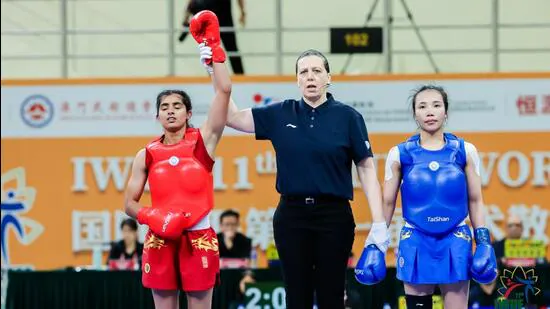
Meet Aparna and Shivani, Indian Wushu’s New Golden Girls
Bharatmorning.com – Two young athletes from India recently made headlines by securing gold medals at the 11th Sanda World Cup held in Macao, China. Aparna Dahiya and Shivani, both aged 22, emerged as the nation’s sole gold medalists, contributing to India’s overall third-place finish in the competition. Their victories in the 58kg and 75kg categories, respectively, marked a significant milestone for the sport in the country, where it remains relatively underrepresented.
Aparna Dahiya: A Journey From Kharkhoda to Global Recognition
Aparna Dahiya, hailing from Kharkhoda village in Haryana, began her wushu journey at the age of 11 when she first joined a school program. What started as a way to learn self-defense quickly evolved into a passion that defined her path. Her father, Bijendra Dahiya, a farmer, and her mother, Beena Devi, a homemaker, provided unwavering support throughout her career. “Tumhe jo karna hai karo. If you want to study, then study; if you want to play, then play,” Aparna recalled, quoting her parents’ philosophy. This belief in her abilities helped her pursue both her academic and athletic ambitions.
“My parents always supported me. They’d often say, ‘Tumhe jo karna hai karo. If you want to study, then study; if you want to play, then play.'”
By the time she reached 19, Aparna had already secured a position as an Income Tax Officer in Mumbai through the sports quota, while continuing her graduation in Physical Education. Her dedication to the sport, however, was driven by more than just career opportunities. “I love the blend of kicking and punching,” she explained. This unique combination of techniques, which distinguishes wushu from other martial arts, became her defining strength. Her triumph in Macao was particularly meaningful, as it allowed her to defeat Thi Phuong Nga Ngo, the reigning world champion, in straight sets. This victory also served as a redemption after a previous loss at the World Wushu Championship in Brasília.
Aparna’s accomplishments include gold at the Wushu Stars Championship 2022 in Moscow and the BRICS Games 2024 in Russia. Her recent silver at the Asian Championships 2024 in Macau further underscores her consistency on the global stage. These achievements have not only elevated her personal profile but also sparked conversations about the potential for wushu to gain more traction in India, a country where the sport still struggles to find a large following.
Shivani: From Dadri to a Medal-Driven Career
Meanwhile, Shivani, the second Indian gold medallist, comes from Dadri in Uttar Pradesh. Her introduction to wushu occurred during her school days, as the region had limited access to other martial arts disciplines. “They only had trainers for wushu,” she said, highlighting how the sport became her first and only option. Her father, Ravindra Kumar, who runs a general store, and her mother, Mithlesh Devi, a homemaker, faced initial skepticism about her choice. “In the beginning, no one liked or supported her playing wushu, not only in society but in the family as well,” Ravindra Kumar told Hindustantimes, reflecting on the challenges his daughter encountered.
“Still, there were people who would mock her saying, ‘Yeh ladko wala game hai, ladki ko lag jayegi.'”
Despite the doubt, Shivani’s perseverance paid off. Her breakthrough came when she earned a job with the Border Security Force (BSF) through the sports quota, which gave her the confidence to pursue wushu full-time. The medals began to accumulate, with her gold at the Sanda World Cup serving as a turning point. Her success has gradually shifted perceptions, both within her community and among family members, who now proudly acknowledge her achievements.
Shivani’s journey mirrors Aparna’s in many ways, though her path has been shaped by different circumstances. While Aparna’s exposure to wushu was broader, Shivani’s early dedication to the sport was a matter of necessity. This distinction has not diminished the significance of her accomplishments, which have become a beacon of hope for aspiring athletes in regions where wushu is not as mainstream.
The Road Ahead: Asiad Dreams and National Ambitions
With their recent triumphs, Aparna and Shivani are now focusing on the upcoming Asian Games in Japan. Their goal is to break the streak of India’s lack of gold medals in wushu, a challenge that has persisted across nine previous Asiad editions. As of now, the nation has only managed to secure a total of 10 medals in the sport, a number that pales in comparison to China’s dominance, which has accounted for 88 medals in the discipline.
Both athletes acknowledge the pressure of representing India on the global stage. For Aparna, the Asian Games represent an opportunity to build on her recent victories and showcase her skills in front of an even larger audience. Similarly, Shivani sees the event as a chance to redefine her legacy and inspire others to follow in her footsteps. Their combined efforts have already begun to create a ripple effect, with more young girls in Haryana and Uttar Pradesh expressing interest in wushu, fueled by their success.
The duo’s achievements highlight the growing potential of Indian wushu. While the sport is still in its nascent stages in the country, their gold medals signal a shift toward recognition and investment. Aparna and Shivani’s stories are not just about personal triumphs but also about overcoming societal expectations and proving that wushu can thrive in India. As they prepare for the Asian Games, their presence in the spotlight is a testament to the power of perseverance and the importance of nurturing talent in unconventional ways.
India’s performance in wushu is often overshadowed by its achievements in more traditional sports like cricket and hockey. However, the rise of athletes like Aparna and Shivani suggests a new era of possibility. Their success at the Sanda World Cup has set a precedent, encouraging others to challenge the status quo. With the Asian Games on the horizon, the nation may soon see a breakthrough that could redefine its identity in the world of martial arts. For now, Aparna and Shivani stand as symbols of a growing movement, proving that gold is not just a dream but a tangible goal within reach.