
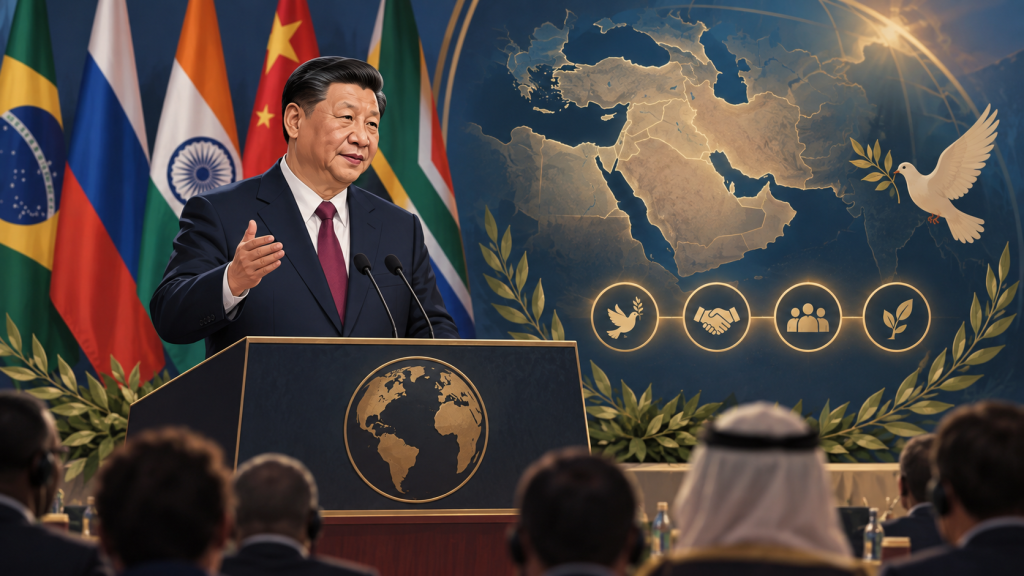
Xi Jinping Calls on BRICS to Push for Peace and Reform at Summit
Bharatmorning.com – Chinese President Xi Jinping used the main session of the BRICS Summit on Saturday to urge member countries to take a more active role in safeguarding international stability, with particular attention to the worsening conflict in West Asia.
Xi said the world is undergoing major changes as the Global South expands its influence and a multipolar international system becomes increasingly evident. At the same time, he warned that unilateral actions, power politics and pressure on the existing global order are contributing to deeper gaps in peace, security and governance.
His address set out a broad agenda for BRICS: protecting peace, advancing innovation, reforming global governance and encouraging exchanges among civilisations. The remarks placed the conflict in the Middle East and Gulf region at the centre of a wider discussion about the future role of emerging economies in global affairs.
Four proposals for West Asia
Xi said developments in the Middle East and the Gulf had become increasingly complicated and called for stronger international efforts to prevent escalation. He presented four proposals intended to support stability in the region, focusing on de-escalation, ending hostilities and creating conditions for a lasting peace.
“The situation in the Middle East and the Gulf region continues to evolve in a complex manner…I put forward four proposals for maintaining and promoting peace and stability in the Middle East, aiming to call for de-escalation, an end to the conflict, and the promotion of peace,” Xi said.
The Chinese leader stressed that the parties involved should pursue a political settlement and work toward a permanent, comprehensive ceasefire. He also pointed to the importance of dealing with the underlying causes of conflict, restoring confidence among countries in the region and building a new regional security framework.
“All relevant parties should adhere to the direction of a political solution and promote a permanent and comprehensive ceasefire. We must attach importance to addressing the root causes of the problems, rebuilding mutual trust among regional countries, and constructing a new security architecture.”
Xi described the Palestinian issue as the central question in the wider Middle East crisis. He said a durable resolution depends on implementing the two-state solution and enabling Israel and Palestine to live alongside each other peacefully.
China, he said, is prepared to work with other BRICS members in efforts aimed at bringing greater calm and stability to the region. The comments reflect the grouping’s continuing emphasis on diplomacy, sovereignty and negotiated solutions to international disputes.
Peace, sovereignty and the UN Charter
Xi linked current instability to what he described as a weakening of the post-war international order and a failure to uphold the United Nations Charter. He said BRICS countries should defend fairness and justice while helping reduce conflict.
“The Brics countries should stand firm, uphold justice and strive to eliminate conflict and maintain peace,” he said.
He urged the bloc to follow a shared approach to security, oppose violations of national sovereignty and reject interference in the domestic affairs of other countries. BRICS members, he added, should also participate in efforts to address major international flashpoints.
The call comes as BRICS seeks to define its place in a global environment shaped by competing security interests, trade tensions and demands from developing countries for greater representation in international decision-making. Xi’s remarks presented the grouping as a platform that can contribute to dialogue while advocating a less concentrated global order.
Artificial intelligence and industrial cooperation
Beyond security, Xi highlighted technological change as a central economic challenge and opportunity. He said advances in artificial intelligence are reshaping development across the world, making stronger cooperation among BRICS countries increasingly important.
“Brics countries must firmly grasp the initiative, strengthen cooperation in AI, encourage open source and open sharing, and promote pragmatic cooperation to new heights,” he added.
Xi proposed the “Brics Initiative on Artificial Intelligence Empowering New Industrialisation.” He said China was willing to cooperate with other members on research and development, while broadening collaboration across industrial and supply chains.
For developing economies, access to AI expertise, computing capacity and industrial applications could influence productivity, manufacturing and public services. Xi’s proposal framed cooperation as a way for BRICS countries to avoid being left behind by a technological transformation largely led by a small number of major economies and companies.
The emphasis on open sharing also fits into the group’s broader argument that technological progress should be more widely available. However, turning that ambition into practical cooperation will require coordination among countries with different technology sectors, regulations and development priorities.
Trade rules and global governance
Xi also called for changes to the way global institutions operate. He said BRICS members should support the multilateral trading system centred on the World Trade Organization, press for WTO reform and resist protectionist measures.
“They should support the multilateral trading system with the World Trade Organization (WTO) at its core, promote WTO reform, oppose the abuse of tariffs, and resist all forms of protectionism,” Xi said.
The WTO remains a key forum for setting and administering international trade rules, but it has faced persistent disagreements over reform, subsidies, tariffs and dispute settlement. Xi’s comments placed BRICS on the side of preserving a rules-based multilateral framework while arguing that the system needs to better reflect present-day economic realities.
His speech connected peace, technology, trade and governance as parts of the same challenge. In Xi’s view, BRICS should not only respond to crises but also help shape the institutions and partnerships that influence global development.
As the Global South gains greater economic and political weight, the debate over who writes international rules is likely to remain central to BRICS discussions. Xi’s proposals suggested that China sees the bloc as an important vehicle for promoting negotiated peace, deeper technological cooperation and a more representative global governance system.
Related Reading
Frequently Asked Questions
What is At BRICS Xi Jinping proposes 4 point?
At BRICS Xi Jinping proposes 4 point is the main topic of this guide. The article explains the context, practical details, and next steps readers should understand.
Why does At BRICS Xi Jinping proposes 4 point matter?
At BRICS Xi Jinping proposes 4 point matters because readers are looking for a useful answer, not just a short summary. Good content should match search intent and help them decide what to do next.