
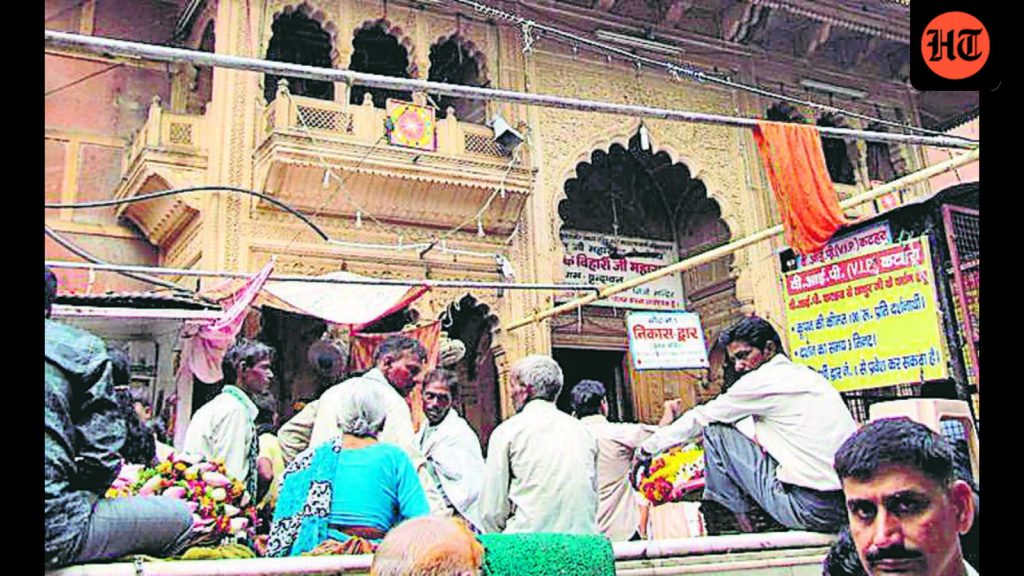
Banke Bihari Temple Panel Considers Limiting Bhandaris to Strengthen Offering Oversight
Bharatmorning.com – A Supreme Court-appointed committee overseeing the administration of Vrindavan’s Banke Bihari Temple is considering a cap on the number of bhandaris allowed to handle offerings made by devotees. The proposal forms part of a wider effort to introduce greater transparency and prevent irregularities in the collection and management of donations at the temple.
The issue was discussed during the committee’s 19th meeting on Tuesday evening, chaired by retired Allahabad high court judge Justice Ashok Kumar. The panel was formed in August 2025 to address persistent concerns connected with the temple’s management and functioning.
Bhandaris are individuals who receive offerings presented by devotees to the deity. The committee’s deliberations focused on ensuring that only properly authorised people can access areas where such offerings are handled, particularly around donation boxes.
“All steps will be taken to counter any irregularities related to offerings and a proposal was discussed to limit the number of ‘bhandaris’ (those who receive offerings made by devotees to the deity),” said justice Ashok Kumar (retired), former judge of Allahabad high court and chairman of the committee.
Concerns over handling of donations
Justice Kumar said the behaviour of some bhandaris stationed close to donation boxes had raised concern. The committee found that offerings were at times retained or passed on instead of being channelled through the prescribed process. It concluded that the temple did not require a large number of bhandaris for this role.
“The conduct of ‘bhandaris’ stationed near donation boxes was found improper. Many a time, they were found to keep the offerings or pass them on and thus a decision has been taken to limit the number of ‘bhandaris’ at the temple because not many are required for the task. None without proper authority will be allowed access to the temple.”
The proposed restriction is intended to make responsibility clearer at a temple that receives a large flow of worshippers and offerings. A smaller, authorised group handling donations could help ensure that every contribution reaches the deity’s funds through an accountable system.
The Supreme Court had already made the principle clear in its August 25 order: all money donated at the temple must first be deposited in the deity’s funds. No person linked to the temple can claim or retain offerings before they enter the temple treasury.
That direction came during proceedings involving allegations that donations were being siphoned off. The court asked the committee supervising the temple to establish a transparent arrangement through which offerings can be properly recorded and accounted for.
Valuables and festival arrangements also reviewed
The meeting was not limited to cash offerings. The committee also examined concerns surrounding valuable items donated to the deity. Complaints had been received that some of these items were not being used in keeping with tradition during special occasions.
For devotees, such donated valuables can carry religious and emotional significance beyond their material worth. The committee’s discussion therefore points to a broader question of how temple property, offerings and ritual practices are managed in a way that respects established customs while maintaining oversight.
Preparations and expenditure connected with Radhashthami were also considered. The committee discussed funds allocated for the occasion, as well as the floral decorations known as phool bangla. These flower settings are among the ceremonial features associated with temple observances and require organised planning when large numbers of devotees are expected.
Crowd conditions in the passage leading to the temple were another matter before the panel. Managing access to the shrine remains an important administrative issue, particularly when religious events increase visitor movement through the approach route.
A wider focus on transparent administration
The committee’s work reflects an effort to bring clarity to several connected aspects of temple administration: donation collection, access control, use of offerings, festival spending, traditional observances and movement of worshippers. The planned mechanism is not simply about counting money; it is also meant to establish a process in which offerings can be traced from the moment they are made by devotees to their deposit in the temple’s funds.
Limiting the number of bhandaris would be one practical part of that framework. By defining who is permitted to receive offerings and who may enter sensitive areas, the temple administration could reduce opportunities for confusion or unauthorised handling.
The panel has stated that it is committed to following the Supreme Court’s directions. Its discussions suggest that future measures at Banke Bihari Temple will place particular emphasis on authorised access, accountable collection practices and the proper use of offerings made in devotion.
As the committee continues its oversight, the central expectation remains unchanged: every offering intended for the deity must be protected by a transparent system and credited to the temple’s funds before it can be used for any authorised purpose.
Related Reading
Frequently Asked Questions
What is Committee mulls cap on number of bhandaris?
Committee mulls cap on number of bhandaris is the main topic of this guide. The article explains the context, practical details, and next steps readers should understand.
Why does Committee mulls cap on number of bhandaris matter?
Committee mulls cap on number of bhandaris matters because readers are looking for a useful answer, not just a short summary. Good content should match search intent and help them decide what to do next.