
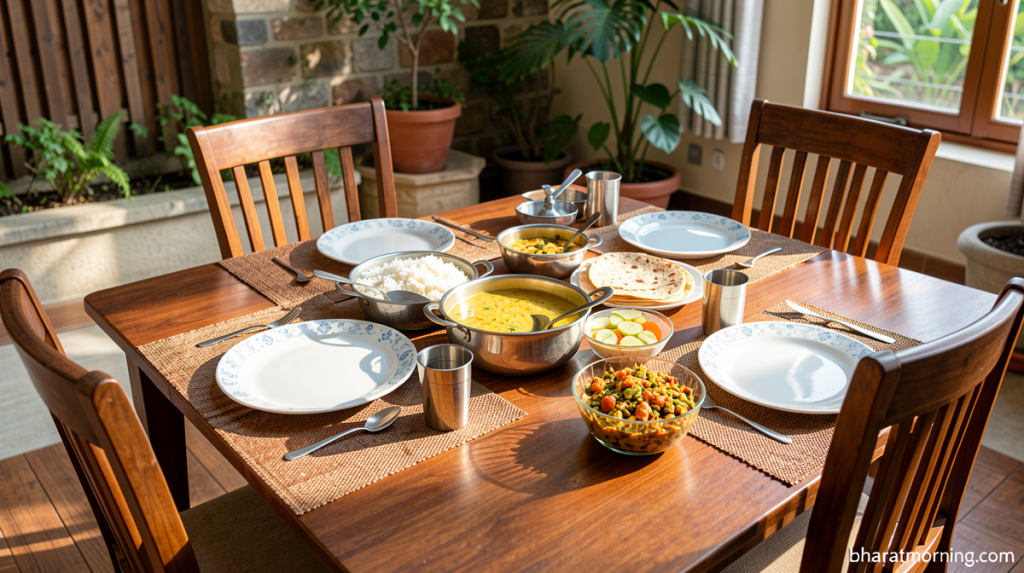
The Quiet Cost of a Late-Night Plate: What Your Dinner Clock Does to Your Arteries
Bharatmorning.com – For most working adults in India, the evening meal is less a scheduled event than a surrender to whatever moment finally allows the kitchen door to open. The commute ends, the last email closes, the children are bathed, and only then does the plate arrive — often well past nine o’clock. This pattern, so deeply embedded in urban routines, has long been treated as a matter of personal preference rather than physiology. Yet a growing body of cardiovascular research now suggests that the hour on the wall when you swallow your last bite may carry consequences for your arteries, your brain’s blood supply, and your metabolic wiring.
Why the Body Keeps Its Own Calendar
Before examining what happens when that calendar is disrupted, it helps to understand what the calendar actually governs. Every human body runs on a roughly 24-hour oscillation called the circadian rhythm. This internal metronome does not merely tell you when to feel sleepy; it orchestrates the release of cortisol, the sensitivity of insulin receptors, the ebb and flow of blood pressure, and the rate at which mitochondria burn fuel. When food arrives at a moment the system has already shifted into its nocturnal maintenance mode, the metabolic machinery is forced to improvise under conditions it was never designed to handle.
Dr Sanjeev Gera, senior director and head of the cardiology department at Fortis Hospital in Noida, frames the issue precisely in those biological terms. He explains that irregular or very late eating can throw the rhythm out of alignment, altering how the body processes glucose and how cortisol levels fluctuate overnight.
“Our body follows a natural 24-hour biological clock, known as the circadian rhythm. It regulates sleep, hormones, blood pressure, and metabolism. Eating very late or at irregular times may disturb this rhythm and affect the way the body manages blood sugar and other metabolic processes, including insulin sensitivity and blood cortisol levels.”
The Scale of the Evidence
The question of whether meal timing correlates with cardiovascular risk is no longer confined to small, single-city cohorts. A 2023 study examined more than one lakh adults over a multi-year window, giving researchers statistical power to detect modest but meaningful shifts in event rates. Dr Gera highlights the magnitude of that dataset when explaining why the findings deserve attention beyond the cardiology literature.
“One of the largest studies examining this question included 103,389 adults and followed them for a median of 7.2 years. During that period, researchers recorded 2,036 new cardiovascular events, including coronary heart disease, stroke and transient ischemic attacks.”
With over two thousand hard endpoints captured across seven-plus years of follow-up, the study could stratify participants by the clock time of their final daily meal and compare outcomes across those strata. The result: individuals whose last meal landed after 9 p.m. showed a statistically elevated risk of cerebrovascular disease relative to those who finished eating before 8 p.m. The association was not limited to one type of vascular event; it spanned coronary heart disease, full-blown stroke, and transient ischemic attacks.
Correlation, Not a Verdict
Dr Gera is careful to draw the line between association and causation. Because the study was observational — participants reported their habits rather than being assigned to a “late-dinner” or “early-dinner” arm — it cannot prove that a 9:30 p.m. meal mechanically causes a plaque rupture. Late eating also travels alongside other habits: later bedtimes, more erratic meal schedules, higher alcohol intake, and reduced physical activity in the evening hours. These co-occurring behaviours may account for part of the observed risk difference.
Still, the cardiologist notes that the sheer size of the cohort and the length of follow-up make the signal difficult to dismiss as noise. Even if confounders explain a portion of the association, the residual link between nocturnal caloric intake and vascular events remains a reason for clinicians to ask patients when, not just what, they eat.
What This Means at the Kitchen Table
The practical implication is not that every post-dinner television episode becomes a cardiac event waiting to happen. Rather, the evidence nudges the conversation from “what should I eat?” toward “when should I finish eating?” For a population already grappling with rising rates of type-2 diabetes, hypertension, and premature coronary disease, the timing variable adds a lever that requires no dietary overhaul — only a shift of perhaps sixty to ninety minutes earlier in the evening.
Cardiologists and sleep-medicine specialists increasingly recommend finishing the last substantial meal at least two to three hours before intended sleep onset. This window allows gastric emptying to progress, keeps insulin demand from peaking during the deepest sleep stages, and aligns caloric intake with the body’s own metabolic peak, which typically occurs in the late afternoon and early evening.
For shift workers, night-shift nurses, and those whose professional schedules invert the conventional day, the advice is less about a fixed clock hour and more about consistency: keeping meal times regular relative to one’s own sleep-wake cycle, rather than drifting hour by hour. Irregularity itself appears to be a risk factor independent of the absolute time.
A Note on Scope
This article is informational and does not replace individualized medical guidance. Anyone experiencing chest discomfort, unexplained fatigue, or neurological symptoms should consult a physician promptly. Adjusting meal timing is a low-risk, reversible lifestyle variable, but it should be discussed within the context of one’s full clinical picture, especially when managing diabetes, hypertension, or post-event cardiac rehabilitation.
Related Reading
Frequently Asked Questions
What is Do you eat dinner after 9 pm?
Do you eat dinner after 9 pm is the main topic of this guide. The article explains the context, practical details, and next steps readers should understand.
Why does Do you eat dinner after 9 pm matter?
Do you eat dinner after 9 pm matters because readers are looking for a useful answer, not just a short summary. Good content should match search intent and help them decide what to do next.