
Three Home Tests That Reveal Your Heart’s True Condition in Under a Minute
Bharatmorning.com – Annual bloodwork, routine check-ups, and the number on a bathroom scale dominate most people’s mental checklist for staying healthy. Yet a prominent Indian cardiologist has argued that a meaningful snapshot of cardiovascular fitness can be obtained without stepping into a clinic, without an echocardiogram, and without waiting weeks for lab results. The tools required are a staircase, a chair, and a pulse check — all available within a typical household.
Dr Naveen Bhamri, who chairs the cardiology department at Max Super Speciality Hospital in Shalimar Bagh and also leads the cardiology unit at BLK-Max Super Speciality Hospital in New Delhi, laid out the three-part protocol in a video posted to his Instagram account on July 31. Each exercise targets a distinct physiological dimension: aerobic endurance, lower-limb functional strength, and autonomic recovery speed. Together they form what he describes as a rapid, self-administered gauge of cardiac well-being.
Test One: The Sixty-Step Sprint
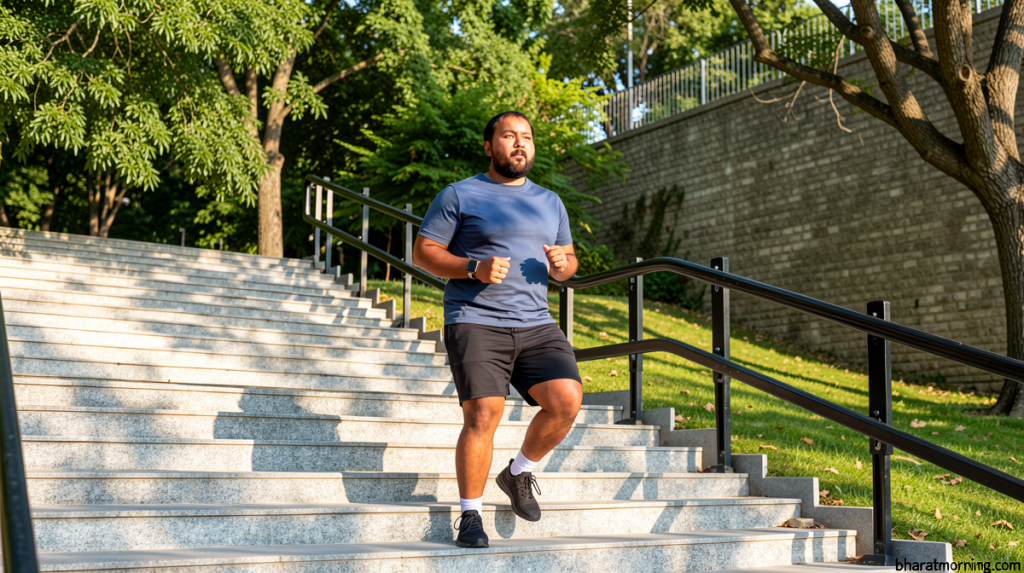
The first challenge probes functional aerobic capacity — essentially how well the heart and lungs sustain a sudden, moderate-to-vigorous demand. The instruction is blunt: ascend sixty consecutive steps within sixty seconds, without pausing and without gripping the handrail.
“You have to climb 60 stairs within 60 seconds without stopping and without holding the railing.”
Dr Bhamri explained that the body’s immediate reaction during that rapid climb acts as a real-time readout of cardiac endurance. If the climber finishes without gasping, without chest discomfort, and without needing to halt midway, the cardiovascular system is handling the acute load efficiently.
“If you are not getting breathless, not experiencing chest pain, and can climb without stopping, then overall you are very fit.”
For context, sixty steps in sixty seconds translates to roughly one step per second — a pace comparable to a brisk stairwell ascent. For adults accustomed to sedentary routines, even half that number can provoke noticeable breathlessness, which itself is a useful data point about current conditioning.
Test Two: The Chair Repetition Count
The second exercise shifts focus from the heart’s pumping capacity to the muscular and skeletal infrastructure that supports daily mobility, a concern that grows more acute after age forty. The setup is minimal: a standard dining or office chair, arms folded across the chest.
The participant sits down and stands up repeatedly, keeping hands off the chair’s arms or backrest throughout. The count matters more than the speed.
“Without holding the chair’s handles, if you can sit and stand more than 16 times without stopping after age 40, it means your fitness is good.”
Conversely, Dr Bhamri flagged a threshold below fourteen repetitions as a signal that overall physical condition warrants attention. The chair test is widely used in geriatric and sports-medicine screening because it isolates quadriceps, gluteal, and core strength while removing the confounding variable of upper-body leverage. A declining count over successive years can precede measurable losses in gait speed and fall risk, making it a practical early-warning metric for middle-aged adults.
Test Three: The One-Minute Pulse Drop
The final assessment examines how swiftly the autonomic nervous system transitions from sympathetic dominance (fight-or-flight) back to parasympathetic control (rest-and-digest) after exertion. Efficient recovery is one of the strongest non-invasive markers of cardiac health; sluggish recovery has been linked in clinical literature to elevated long-term cardiovascular risk.
The protocol calls for three to five minutes of continuous aerobic activity — running, stair climbing, or treadmill walking at a moderate-to-vigorous intensity. The moment the effort stops, the participant records a baseline pulse. Exactly sixty seconds later, a second reading is taken. The difference between the two numbers is the recovery score.
“If your heart rate drops by more than 25 beats, it means you have excellent recovery.”
A drop of fewer than twelve beats, by contrast, signals that the heart is struggling to return to baseline efficiently.
“Your overall cardiac fitness is not good.”
Researchers have long noted that a healthy adult’s heart rate should fall by roughly 12 to 25 beats within the first minute post-exercise; values above that range correlate with superior vagal tone and lower all-cause mortality in large cohort studies. Dr Bhamri’s framing places the upper end of that spectrum as the benchmark for “excellent” recovery.
Reading the Results — and Knowing When to Stop
These three checks are wellness indicators, not diagnostic instruments. They can flag trends over weeks or months and motivate a conversation with a physician, but they cannot replace imaging, stress testing, or laboratory panels. Anyone who experiences chest tightness, pronounced dyspnea, lightheadedness, or palpitations while performing any of the exercises should cease activity and seek professional medical evaluation promptly.
The broader implication is practical: a person with no recent cardiac workup can obtain a rough, same-day picture of cardiovascular readiness using nothing more than a staircase, a chair, and a smartwatch or manual pulse check. Repeating the battery monthly and tracking trends — whether the stair count is climbing, the chair reps are holding steady, or the pulse drop is widening — gives a layperson a structured vocabulary for discussing fitness with a cardiologist, rather than arriving at an appointment with only a vague sense of “feeling okay” or “feeling off.”
Dr Bhamri’s video drew attention partly because it translated concepts normally confined to exercise-physiology textbooks into language a general audience can execute safely at home. The underlying physiology is well established; the contribution is packaging. In an era where preventive cardiology increasingly emphasizes patient self-monitoring between clinical visits, even a sixty-second staircase climb may serve as a low-cost, high-signal entry point into a longer conversation about heart health.
Related Reading
Frequently Asked Questions
What is 60 stairs in 60 seconds Cardiologist?
60 stairs in 60 seconds Cardiologist is the main topic of this guide. The article explains the context, practical details, and next steps readers should understand.
Why does 60 stairs in 60 seconds Cardiologist matter?
60 stairs in 60 seconds Cardiologist matters because readers are looking for a useful answer, not just a short summary. Good content should match search intent and help them decide what to do next.