
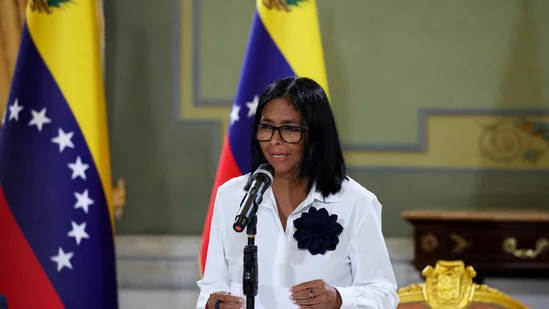
Venezuela’s Interim President Delcy Rodriguez to Visit India in June for Energy Collaboration Talks
Bharatmorning.com – India’s Ministry of Foreign Affairs announced on Tuesday that Venezuela’s interim President Delcy Rodriguez will embark on a high-level visit to the country from June 3 to June 7. This trip coincides with New Delhi’s intensified efforts to secure crude oil supplies from Caracas, as the nation seeks to diversify its energy procurement sources amid global market volatility.
Rodriguez, who previously served as Venezuela’s oil minister, will lead a delegation focused on strengthening energy partnerships during her visit. Her engagement with India’s leadership is expected to highlight the strategic importance of bilateral ties, particularly in navigating the complex landscape of international oil trade. The timing of her arrival underscores a renewed emphasis on collaboration, as India continues to ramp up its imports from Venezuela to offset supply chain challenges.
India’s energy demand has surged in recent months, with the nation emerging as the second-largest importer of Venezuelan crude oil in May. According to data from Reuters, India procured 427,000 barrels per day of Venezuelan oil during that period, trailing only the United States in volume. This increase in purchases reflects India’s growing reliance on Venezuela as a key supplier, especially given the ongoing geopolitical tensions in the Middle East.
The Indian Ministry of Foreign Affairs confirmed that Rodriguez will meet with Prime Minister Narendra Modi during her stay. These talks are anticipated to cover a broad range of bilateral relations and examine potential opportunities for further cooperation. As per the ministry’s spokesperson, Randhir Jaiswal, the discussions will delve into areas such as energy, trade, investment, pharmaceuticals, healthcare, transportation, and renewable energy initiatives.
“
The conversations will address the full spectrum of India-Venezuela relations and identify pathways for enhanced collaboration in critical sectors like energy and trade,” Jaiswal remarked during a media briefing. “This visit aims to solidify existing partnerships while exploring new avenues for mutual benefit.”
Rodriguez’s return to India marks her second official visit since assuming the role of interim president. In February 2025, she had previously participated in the India Energy Week conference as Venezuela’s oil minister, showcasing the country’s energy portfolio to international stakeholders. Her current mission builds on that foundation, with a focus on deepening ties in a sector vital to India’s energy security.
India’s energy strategy has been shaped by the disruptions in global oil markets, particularly those stemming from the U.S.-Israeli conflict with Iran. The Strait of Hormuz, a crucial maritime route, has seen near-complete closures due to the escalating tensions, significantly impacting South Asian oil imports. This development has compelled India to seek alternative suppliers, with Venezuela becoming a strategic partner in the process.
India had temporarily suspended its purchases of Venezuelan oil in 2024, following the imposition of a 25% discretionary tariff by U.S. President Donald Trump. The policy targeted countries relying on Venezuelan crude, disrupting trade flows and prompting India to reduce its imports. However, the nation resumed buying Venezuelan oil in February 2025 after sanctions were eased, following a landmark agreement between Washington and Caracas.
The U.S.-Venezuela agreement, finalized in January 2025, has redefined the dynamics of their energy partnership. Under the terms of the pact, the United States maintains oversight of the revenue generated from Venezuelan oil exports, with the Treasury Department managing key financial aspects. Commercial agreements also align with Washington’s guidance, ensuring continued integration of Venezuelan crude into the global supply chain.
As India’s energy needs grow, the resumption of Venezuelan oil imports has provided a critical buffer against supply shortages. The collaboration between the two nations is part of a broader effort to stabilize energy markets and reduce dependency on a single region. Rodriguez’s visit is expected to reinforce this partnership, with both sides aiming to expand their economic and strategic engagement.
The geopolitical significance of this visit cannot be overstated. With the U.S. maintaining a strong presence in global oil markets, Venezuela’s ability to secure trade agreements has been a key factor in its economic recovery. India’s engagement with Caracas offers a counterbalance to U.S. influence, allowing the South Asian nation to explore diverse energy options while supporting Venezuela’s efforts to sustain its oil exports.
Rodriguez’s talks with Modi are likely to address India’s long-term energy goals, including the development of renewable energy infrastructure and the modernization of its oil refining capabilities. The Indian government has emphasized the need for energy diversification, and Venezuela’s oil reserves provide a reliable resource in this endeavor. Additionally, the discussions may touch on broader economic cooperation, such as investment in infrastructure and joint ventures in pharmaceutical and healthcare sectors.
The recent resumption of oil trade between India and Venezuela has also been influenced by the evolving U.S. policy toward the South American nation. After the U.S. capture of President Nicolas Maduro in January, a new framework was established to regulate oil transactions, ensuring transparency and stability in the sector. This agreement has allowed India to reengage with Venezuela’s energy market, reinforcing its role as a key player in the region’s oil trade.
As the world’s third-largest oil importer and consumer, India faces mounting pressure to secure stable and affordable supplies. The collaboration with Venezuela, combined with its existing partnerships with other producers, positions the nation to navigate these challenges effectively. Rodriguez’s visit serves as a testament to the resilience of India-Venezuela relations, even in the face of political and economic shifts.
Analysts suggest that the visit will also address the broader implications of U.S. sanctions on Venezuela’s oil industry. By resuming purchases, India has demonstrated its commitment to maintaining trade continuity, despite Washington’s ongoing restrictions. This move could have ripple effects on the global oil market, as other nations may follow suit in seeking alternative suppliers to mitigate the impact of geopolitical tensions.
In conclusion, the upcoming visit by Venezuela’s interim president to India highlights the nation’s strategic importance in the global energy landscape. As both countries work to strengthen their ties, the discussions are expected to pave the way for a more robust and diversified energy partnership, benefiting India’s supply chain and Venezuela’s economic recovery efforts.