
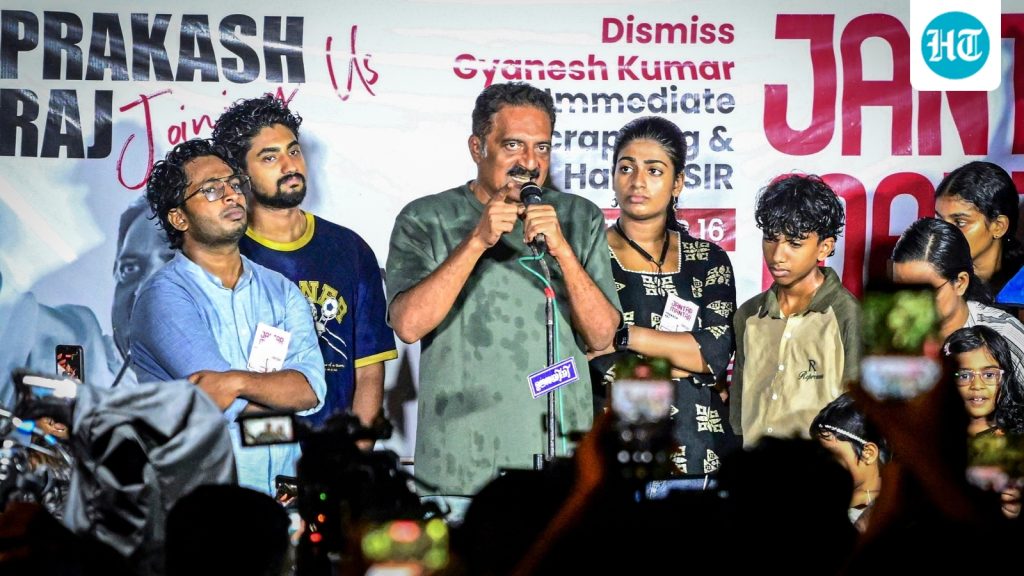
Prakash Raj vows peaceful protests will continue over CEC and electoral roll revision
Bharatmorning.com – Actor and activist Prakash Raj has said demonstrations against Chief Election Commissioner Gyanesh Kumar and the Special Intensive Revision of electoral rolls will continue across India, despite police action and restrictions faced by protesters.
Raj spoke in Thiruvananthapuram on Friday after attending a protest gathering at Manaveeyam Veedhi. He framed the agitation as a democratic effort by citizens seeking answers, saying attempts to curb peaceful assembly would not end the movement.
“There is Gandhi’s blood in us. There is Ambedkar’s blood in us, there is Bhagat Singh’s blood in us.”
He said protesters would draw inspiration from Mahatma Gandhi, B R Ambedkar and Bhagat Singh while maintaining a non-violent approach. Raj argued that people would continue raising difficult questions even if authorities attempted to prevent public meetings or detain participants.
“We will continue to fight, we will continue to protest peacefully across the country, and it will prove you wrong that you can get away with this dictatorship.”
Questions over restrictions on demonstrations
Police intervened before the Thiruvananthapuram meeting began, resulting in a brief confrontation with organisers. Officers said permission had not been obtained to use a microphone at the venue. After a minor tussle, the gathering was allowed to proceed.
Raj questioned why a peaceful protest should require such intervention. He said stopping or detaining demonstrators raised concerns about the treatment of citizens exercising their right to dissent.
“We are asking questions: Gyanesh Kumar, why are you stopping us? The very fact that you are stopping us, detaining us illegally, shows something is wrong.”
The actor said India’s democratic character depends on the ability of people to question those in authority. In his view, peaceful protest is not an act against the country but a means through which citizens, workers, students and farmers can express concerns.
He said farmers, labour unions and student organisations could take part in the wider protest movement. The comments came amid demonstrations linked to concerns over the electoral roll revision exercise and action against protesters in different parts of the country.
“The people of this country, the farmers of this country, the labour unions of this country, and all the student organisations will come to the streets and protest peacefully till you clear us out.”
Call for answers from authorities
Raj rejected the suggestion that those participating in demonstrations should be viewed as a threat. He said young people and other citizens asking questions should not be treated as offenders merely because they challenge those in power.
“What do you mean by protest? Are they terrorists? The youth and the people of this country are doing a peaceful protest. Is that a crime in this country? It is a crime for you because we are asking difficult questions to which you don’t have answers.”
The Special Intensive Revision, often referred to as SIR, concerns the process of reviewing electoral rolls. Electoral rolls determine who is eligible to vote, making their accuracy a central part of the election system. Raj’s remarks placed the protests in the broader context of public concern over accountability, democratic participation and the right to challenge official decisions.
He also said he expected police personnel to eventually resist orders they considered unfair toward peaceful demonstrators. Raj noted that police officers and members of the armed forces are citizens as well, and suggested they would recognise the difference between maintaining public order and suppressing dissent.
“I trust the police will get tired and tell (PM) Modi and (HM) Shah, ‘We are not your workers. Please stop making us do this.’ The army will stop saying, ‘No, we can’t do this.’ They are also human beings, they are also citizens of this country.”
Movement could expand, Raj says
Raj said international human rights organisations would strongly criticise action taken against protesters. He also pointed to farmers’ stated support for young demonstrators and suggested the campaign could expand beyond the scale of the recent protest at Jantar Mantar in Delhi.
“Let us see. It’s going to be a bigger fight, a bigger protest than what you saw in Jantar Mantar.”
His comments underline the growing political significance of public protest around electoral processes and civic rights. For Raj, the central issue is whether citizens can freely seek explanations from constitutional authorities and gather without being treated as criminals.
While the immediate dispute in Thiruvananthapuram involved the use of a microphone at a public meeting, Raj presented it as part of a wider debate. He maintained that democratic institutions are strengthened when citizens are allowed to question decisions openly and peacefully.
The actor’s message to supporters was that the protests would remain non-violent but persistent. He said the movement would continue in cities and communities across the country, with participants seeking clarity on the Special Intensive Revision and objecting to restrictions placed on demonstrations.
Related Reading
Frequently Asked Questions
What is Prakash Raj says anti CEC protests?
Prakash Raj says anti CEC protests is the main topic of this guide. The article explains the context, practical details, and next steps readers should understand.
Why does Prakash Raj says anti CEC protests matter?
Prakash Raj says anti CEC protests matters because readers are looking for a useful answer, not just a short summary. Good content should match search intent and help them decide what to do next.