
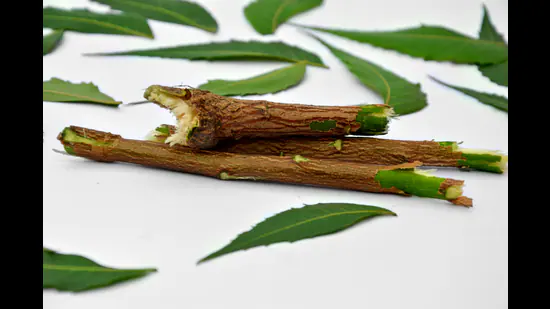
Spice of Life | $7 for Daatun! Humble Twig Is Internet’s Latest Organic Luxury
Bharatmorning.com – While browsing Amazon one afternoon, I paused mid-scroll. There, nestled among everyday items, was a bundle of chewing sticks—15 for $7 (₹666). A faint smile tugged at my lips, blending amusement with wonder. What was once a随手 plucked natural remedy now sits neatly packaged, ready for global delivery. The daatun, a simple twig, has crossed oceans and entered the realm of modern convenience.
A Daily Ritual
Before the era of electric toothbrushes and minty foams, mornings were marked by the earthy ritual of chewing a fresh twig. “Abhi to maine daatun bhi nahin ki”—I haven’t even brushed yet—was a common excuse for delaying the day. Yet, for many, this act wasn’t just about cleanliness; it was a quiet communion with nature and tradition.
The daatun was a multifunctional tool. It served as a brush, a paste, and a tool for cleaning the tongue, all in one slender, biodegradable form. Its versatility made it indispensable, especially in homes where cosmetics were a rare indulgence. Rangli-daatun, crafted from walnut bark, left a soft lip tint while tending to dental health. Beauty arrived unannounced, tucked into the fabric of daily life.
The Modern Shift
As a young adult, I grew fond of khajoor-daatun (date-palm twig), treating it like a cherished habit. We would select the sturdiest sticks, chewing them with unwavering dedication until they wore down into fine fibers. The ritual was a blend of discipline and delight, a testament to the simplicity of oral care.
Years later, my transition to toothpaste was reluctant. But my colleague clung to babul-daatun with steadfast devotion. His loyalty required effort: long walks through rain or sun to collect his preferred twig. One such evening remains vivid. Rain poured relentlessly as we searched for the vendor, only to find him absent. A nearby fruit seller offered the twigs without asking for payment. “He’s left them here for regular customers like you,” he said. It was a gesture of trust, a small act in a world of transactions.
“He’s left them here for regular customers like you,” he said.
That moment encapsulated an economy of care, where value was measured in time and tradition rather than price tags. It felt almost radical, a reminder of a bygone era when simplicity reigned. At home, my grandmother never needed endorsements. To her, the daatun was a miracle—neem for killing germs, babul for strengthening gums, ber to sweeten the voice, and miswak to freshen breath. Her knowledge was rooted in lived experience, not marketing slogans.
Reclaiming the Past
Today, the daatun has found a new audience. Once a routine part of life, it is now branded as “organic, sustainable, and eco-friendly.” The old twig dons a fresh vocabulary, yet its core remains untouched. It offers a stark contrast to the excess of modern consumerism, where products are often flashy but fleeting. This resurgence is not merely a trend—it is a return to values that predate industrialization.
Yet, the daatun’s essence persists. It requires no packaging, no electricity, and no instruction manual. Its power lies in its simplicity, a reminder that some solutions have always been at hand. As we navigate an era of overproduction and disposable goods, the twig’s enduring presence feels almost revolutionary. It invites us to slow down, to connect with the earth, and to rediscover what was once taken for granted.
The internet has become a bridge, linking rural traditions to urban lifestyles. Daatun, once a village courtyard staple, now graces digital carts with a label of luxury. But this transformation is not about losing authenticity—it is about amplifying it. In a world where sustainability is a buzzword, the daatun stands as a quiet symbol of ancestral wisdom. Its journey from tree to shelf is a story of adaptation, not abandonment.
Tomorrow, as the sun rises, I may find myself reaching for a twig once more. Not out of need, but out of nostalgia. For in that small, fibrous piece, there is a taste of a simpler time—a time when care was not a commodity but a habit. The daatun endures because it carries the soul of a practice that transcends trends. It is a link to a past that, in its quiet way, still shapes the present.
As the demand for organic products grows, so too does the appreciation for the daatun. It is no longer just a tool for oral hygiene; it is a vessel of cultural memory. In a fast-paced world, this humble item offers a gentle counterpoint, urging us to pause and remember. Its resurgence is a celebration of nature’s ingenuity, a reminder that the best solutions often lie in the simplest of forms. The daatun, in its enduring presence, whispers a truth that modern life sometimes forgets: that value can be found in the unassuming, and that sustainability is not a new idea but an old one, waiting to be reimagined.