
Caste, Merit and the Failure of Social Empathy
Bharatmorning.com – India’s constitutional promise of equality has long been tested by a stubborn social reality: caste continues to shape access to education, employment, relationships and public life. Yet debates around reservation often proceed as though caste itself has disappeared, while affirmative action alone has become the central source of unfairness. That reversal has narrowed public understanding of discrimination and made meaningful empathy far more difficult.
The tension surfaced almost immediately after the Constitution came into force. India’s founding document, among the longest written constitutions in the world, was prepared over 165 sittings spanning nearly three years. Within six months of its enactment, however, a challenge from Tamil Nadu brought the conflict between formal equality and social justice before the courts.
An Early Constitutional Clash
Champakam Dorairajan, a 35-year-old Brahmin woman, had received a science degree from the University of Madras in 1934. Financial constraints prevented her from pursuing medicine at the time. When she returned to that ambition 15 years later, she encountered a Madras government order that distributed medical-college seats across caste communities according to population.
Before submitting an application, Dorairajan challenged the arrangement in the Madras High Court. She was joined by CR Srinivasan, a Brahmin student seeking admission to an engineering programme. Their case posed a foundational question for the new republic: should equality mean that the State ignores caste in admissions, or should it recognise caste disadvantage in order to correct it?
The High Court invalidated the communal order, and the Supreme Court upheld that outcome in 1951. The judgment concluded that admissions could not be determined on the basis of religion, race or caste. Its reasoning gave priority to a literal interpretation of fundamental rights over the Constitution’s directive principles, and it dealt a serious blow to the early framework for reservations.
That legal position soon proved politically and socially untenable. The resulting impasse contributed to the first constitutional amendment, which inserted protection for affirmative action among several other contested changes. BR Ambedkar, then law minister, strongly disagreed with the court’s separation of caste from merit.
“Every Hindu has a caste — he is either a Brahmin or a Mahratta or a Kunby or a Kumbhar or a carpenter. There is no Hindu — that is the fundamental proposition — who has not a caste,” he said in Parliament.
Ambedkar’s point was not merely that caste labels existed. It was that social opportunity could not be discussed honestly while pretending those labels had no effect on people’s lives. A supposedly neutral standard of merit can preserve older advantages when access to education, social networks and institutional confidence has never been equally distributed.
Why the Argument Has Endured
More than seven decades later, reservation remains an emotional and divisive subject. Social change, political representation and greater mobility among sections of marginalised communities have not dissolved upper-caste resentment. In many cases, they appear to have intensified it.
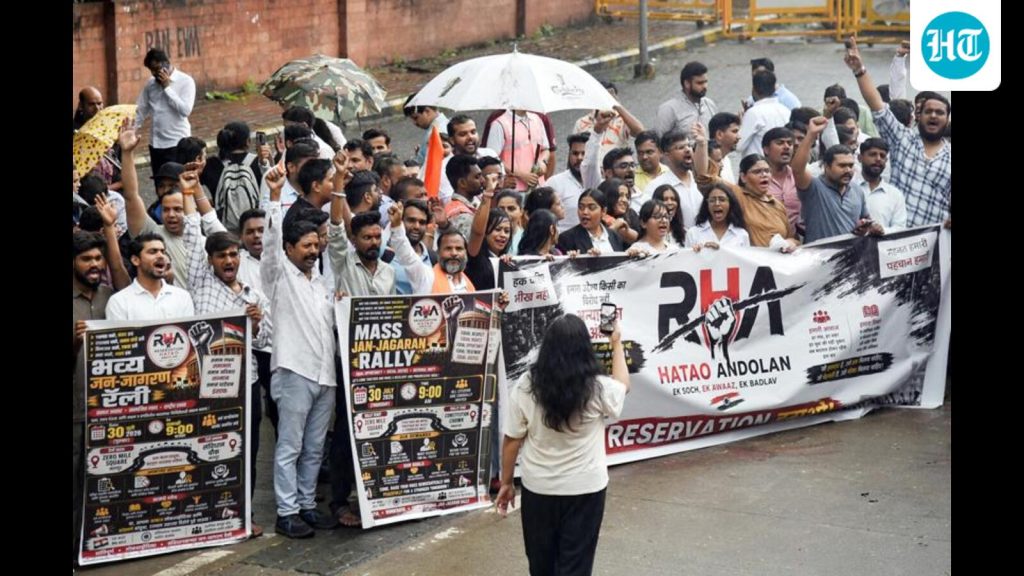
Public opposition has repeatedly framed quotas as an assault on merit. The debate has produced dramatic protests, including a medical student’s self-immolation against the Mandal mandate and demonstrations by women students speaking on behalf of hypothetical unemployed husbands. Such moments have reinforced an imagined divide between competence and caste-based redress, as if the two can never coexist.
But caste has not ceased to influence life chances. Its effects may be less openly acknowledged in some spaces, yet birth can still affect entry into classrooms and campuses, the likelihood of receiving a job-interview callback, patterns of friendship and marriage, experiences of loss, and even access to burial or cremation grounds. These realities complicate the claim that competition begins from a common starting line.
The contradiction is especially visible in responses to the economically weaker sections, or EWS, category. Many people from dominant communities now receive the benefit of reservation through this route, which functions as an upper-caste quota. It has not attracted the same stigma routinely attached to students described dismissively as “quota students.” The difference reveals how objections to reservation are often directed less at the principle of support than at the social groups receiving it.
The Myth of Casteless Merit
Demands for quotas from communities that once fiercely resisted affirmative action illustrate a selective memory about privilege. Connections, family standing, educational familiarity and community networks are frequently treated as individual achievement. Advantages built over generations are recast as personal diligence, while assistance intended to address historical exclusion is portrayed as an undeserved shortcut.
Historian Ajantha Subramanian has examined the way caste and merit are made to appear inseparable in public thinking. That construction permits a damaging assumption: identity-based politics is imagined as something practised only by marginalised groups, while dominant castes can see themselves as having moved beyond caste altogether. Such self-image obscures the continuing influence of social location.
The result is a discourse in which reservation, rather than caste hierarchy, is often named as the problem. Dalits become the most visible symbol of discrimination, while those who benefit from entrenched bias—or perpetuate it—remain less visible. The language of merit can then function as a shield against examining who has historically been allowed to accumulate security, confidence and opportunity.
Beyond Electoral Symbolism
Electoral necessity has compelled political parties to support reservations, but that support has often lacked depth. Commitment to social justice cannot be measured only through slogans or formal endorsements. It must also be reflected in the transparent filling of reserved posts and seats, in campus conditions for marginalised students, and in the willingness of parties to broaden their own leadership.
It remains telling when parties led largely by upper-caste politicians rarely nominate Dalit candidates outside constituencies reserved for them. This pattern suggests that social justice can become an electoral emblem rather than a wider project of national reconstruction. Representation is reduced to compliance, rather than understood as participation in political power.
The most serious consequence of this failure is social distance. An upper-caste Indian can move through life without close Dalit friends or colleagues, without sharing a home, forming an intimate relationship, or standing beside a Dalit family in grief. Such separation makes it easier to view reservation only as a personal loss rather than as one limited effort to repair a deeply unequal society.
When opportunities are regarded as inherited entitlements, empathy gives way to grievance. A more honest debate must begin by recognising that caste has never been absent from the distribution of merit, dignity or possibility. Until that recognition becomes common, arguments about equality will continue to evade the inequalities they claim to address.
Related Reading
Frequently Asked Questions
What is Caste bias has made empathy impossible?
Caste bias has made empathy impossible is the main topic of this guide. The article explains the context, practical details, and next steps readers should understand.
Why does Caste bias has made empathy impossible matter?
Caste bias has made empathy impossible matters because readers are looking for a useful answer, not just a short summary. Good content should match search intent and help them decide what to do next.