
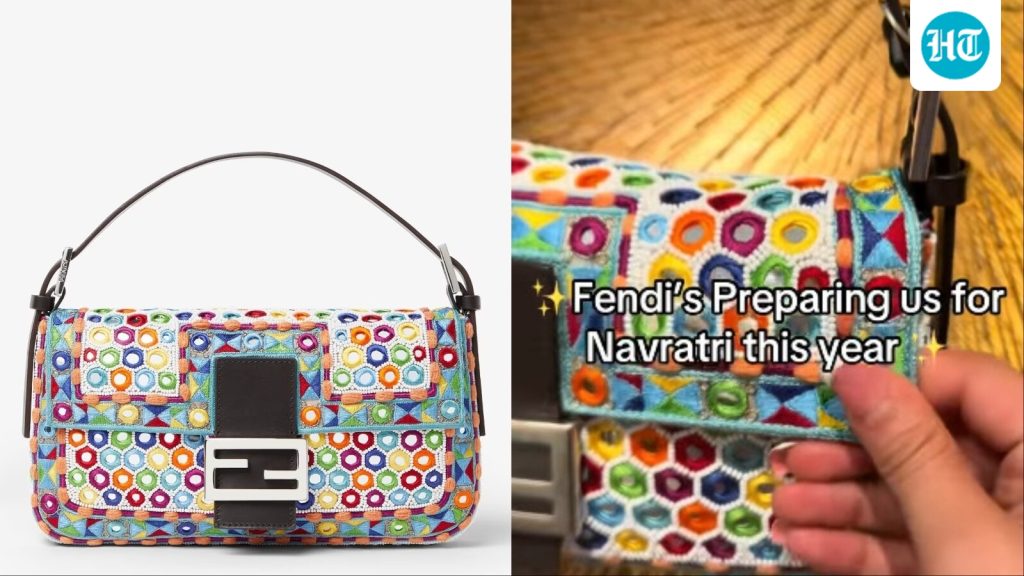
Fendi’s mirror-work Baguette sparks debate over credit for Indian craft
Bharatmorning.com – A Fendi handbag priced at $10,000, or roughly ₹9.59 lakh, has prompted a wider conversation online about recognition, authorship and the visibility of Indian artisans in global luxury fashion. The Italian label’s multicoloured Baguette design uses dense embroidery, beads and mirror embellishments that many social media users have linked visually to craft traditions associated with Gujarat and Rajasthan.
Often described online as the “Navratri bag,” the piece has become the focus of criticism not simply because of its appearance, but because of questions over how clearly luxury brands acknowledge the communities and craftspeople involved in making such designs.
A highly detailed luxury accessory
Fendi lists the product as the Baguette 26424 Multicolour Re-Edition. The bag is marked Made in Italy and is decorated with 39,500 beads and 475 mirrors. Its creation required more than 138 hours of craftsmanship, highlighting the intensive handwork behind the accessory.
Its vivid surface, mirror accents and ornamental beadwork have drawn comparisons with Indian festive aesthetics. For many observers, those elements evoke the visual language commonly seen in Gujarati and Rajasthani embroidery and mirror-work, particularly in clothing and accessories worn during celebrations such as Navratri.
The discussion has therefore moved beyond a single designer bag. It has become a reader-facing example of a recurring question in fashion: when a global house incorporates a recognisable craft vocabulary, how prominently should it identify the people, places and skills connected to that work?
Calls for clearer attribution
Indian social media users, including industrialist Harsh Goenka and philanthropist Kiran Mazumdar Shaw, have joined the debate around cultural appropriation and credit. Their reactions reflect concern that traditional Indian techniques can be incorporated into high-value international products without enough public acknowledgement of the artisans whose expertise makes those pieces possible.
Fashion watchdog Diet Paratha added another dimension to the conversation in an Instagram post. It said that Indian artisans from Mumbai’s Chanakya School of Craft created both the 1995 version of the mirrored bags and the current design.
If Indian craftsmanship is an integral part of the product’s story, shouldn’t Fendi be telling that story more visibly… Proper attribution needs to come directly from global luxury houses,
the user wrote in response to the post.
Other comments reflected frustration with the wider fashion cycle, in which cultural references can spread rapidly online before their origins are discussed. One user said:
Brands these days are purposely launching rage bait designs.
Another comment read:
Everyone has to steal something from India but hesitate when it comes to giving credit.
Why the distinction matters
Craft influences have long travelled across borders, and fashion regularly draws on techniques, motifs and forms developed in different regions. The issue raised by this case is not that a luxury product contains embroidery or mirror-work. It is whether the product story gives consumers a clear and meaningful account of the makers behind it.
For shoppers, attribution can change how an object is understood. A description that identifies artisan participation, the craft tradition involved and the relationship between the brand and makers offers more than decorative context. It helps explain the labour, knowledge and cultural history embedded in the finished piece.
That visibility is especially significant when a product carries a luxury price tag. A bag valued at ₹9.59 lakh is presented as an exceptional object, and its hours of handwork form part of that value. When Indian artisans and their methods are involved, critics argue that their contribution should be treated as central to the design’s identity rather than as a background detail.
The debate also points to the difference between inspiration and collaboration. Inspiration can remain vague, while collaboration creates a more specific relationship between a brand and the people who supply specialised skill. Publicly naming partners, artisans or institutions can make that relationship easier for customers to recognise.
Response awaited from Chanakya School of Craft
Chanakya School of Craft was contacted for a response but had not replied by the time of publication. Its role, as described in the Instagram post, remains a key point of interest for those questioning how the bag has been presented to consumers.
The response to Fendi’s Baguette shows how quickly fashion audiences now examine the stories behind luxury objects. Design details that may once have been viewed only as ornament are increasingly being discussed in terms of origin, labour and acknowledgement.
For Indian observers, the mirror-work bag has become a conspicuous reminder that craft is not merely a visual resource. It carries the expertise of artisans, regional traditions and generations of knowledge. The central demand emerging from the online discussion is straightforward: when that craft is integral to a global fashion product, its makers deserve visible credit.
Related Reading
Frequently Asked Questions
What is The curious case of Fendi s 9?
The curious case of Fendi s 9 is the main topic of this guide. The article explains the context, practical details, and next steps readers should understand.
Why does The curious case of Fendi s 9 matter?
The curious case of Fendi s 9 matters because readers are looking for a useful answer, not just a short summary. Good content should match search intent and help them decide what to do next.